LEED Existing Building: Operations and Maintenance- LEED EB:OM Check List

 Comments Off on LEED Existing Building: Operations and Maintenance- LEED EB:OM Check List
Nov 262012
 
Sustainable Sites  26 Points
Possible Credit   Credit Title YES / NO Man Hours Required  Cost to Implement
Points Number
LEED Certified Design and Construction
4 Credit 1
Comments: Is   this property certified under LEED NC or CS — if yes to either, 4 points are   earned.
Building Exterior and Hardscape Management Plan
1 Credit 2
Comments: Is there a Building Exterior and   Hardscape Management Plan in place?  If   yes, 1 point is earned.
1 Credit 3 Integrated Pest Management (IPM), Erosion Control, and Landscape   Management Plan
Comments: Is   there an IPM, Erosion Control and Landscape Management Plan in place? If yes   to all, 1 point is earned.
3 to 15 Credit 4 Alternative Commuting   Transportation
Comments: Can you demonstrate the   percentage of reduction in conventional commuting trips by car carpooling,   bicycling and public transportation access?    Points are earned by the following percentage reductions:  10%=3: 13.75%=4; 17.5%=5; 21.25%=6; 25%=7;   31.25%=8; 37.5%=9; 43.75%=10; 50%=11; 56.25%=12; 62.5%=13; 68.75%=14; 75%=15
1 Credit 5 Site Development: Protect or Restore Habitat
Comments:  Find Property proportional to the land under LEED consideration that will be untouched with native habitat. On site or offsite
1 Credit 6 Storm water Quantity Control
Comments: Does site have a storm water   management plan in place that collects & resuses runoff or   evapotranpirates runoff from at least 15% of precipitation falling on the   whole project site both for an average weather year and for the 2 yr, 24 hour   design storm.  If yes, 1 point earned
1 Credit 7.1 Heat Island Reduction – Nonroof
Comments: Does   site have 50% of parking under cover with roof comprised of solar panels, SRI   of 29, or vegetated roof?  Or does the   site have an open grid paving system at least 50% pervious, or provide shade   for at least 50% of the hardscape? If yes to any, earn 1 point.
1 Credit 7.2 Heat Island Reduction – Roof
Comments: Does   the site have a vegetative roof at least 50% of roof area?  Or is 75% of the roof comprised of solar   reflectant materials (SRI)?  If yes to   either, earn 1 point. Roof replacements can be a part of a typical project,   especially if roof insulation is added or “cool roofs” are installed.   Installation of a “cool roof” or “green roof” may allow the accomplishment of   credit SSc7.2. It is also possible for the owner to include other green   performance measures in the project, such as landscaping materials,   stormwater management structures, shade structures or pervious paving   materials.
1 Credit 8 Light Pollution Reduction
Comments: Document   that all exterior lights 50 watts or greater are partially or fully shielded   so that they do not directly emit light to the night sky and document that   all non-emergency lights with direct line of sight to the exterior of the   building are automatically controlled to turn off during after-hours periods   (a minimum of 6 hours/day).
Water Efficiency  14   Points 
Possible Credit   Credit Title YES / NO Man Hours Required  Cost to Implement
Points Number
REQ Prereq 1 Minimum Indoor Plumbing and Fitting Efficiency
Comments: Was   the building constructed after 2006? If yes, then the base line will be   met.   If the building was built   between 2005 and 1993 the property will need to achieve 120% of baseline   derived from the 2006 calculations. If build prior to 1993, the property will   need to achieve 160% of the baseline derived from the 2006 calculations.
2 Credit 1 Water Performance Measurement
Comments: Does the building have 1 main   water meter for the entire property? If yes, 1 point is earned. If in   addition to the main meter, there are 1 or more base building sub-meters, 2   points are earned.
5 Credit 2 Additional Indoor Plumbing Fixture and Fitting Efficiency
Comments: Reduction of potable water use   from baseline (WE Preq. 1). 10%=1pt, 15%=2pts, 20%=3pts, 25%=4pts, 30%=5pts.
5 Credit 3 Water Efficient Landscaping
Comments: Reduce   potable water consumption for landscaping. 50%=1pt, 62.5%=2pts, 75%=3pts,   87.5%=4pts., 100%=5pts.
2 Credit 4 Cooling Tower Water Management
Comments: Does the property have a Water   Treatment program in place?  Program   must include: automatic control of tower “bleed-off”, biological   control and staff training?  If yes, 1   point is earned. Does the cooling tower utilize non-potable water for at   least 50% of required make up? If yes, 1 point is earned.  If yes to all, 2 points total are earned.
Energy & Atmosphere  35   Points 
Possible Credit   Credit Title YES / NO Man Hours Required  Cost to Implement
Points Number
REQ Prereq 1 Energy Efficiency Best   Management Practices – Planning, Documentation, and   Opportunity Assessment
Comments: Does the building have a   written sequence of operations?  Does   the building have a written Operating Plan?    Plan must include an occupancy schedule, equipment run-time schedule(s),   design set points for all HVAC equipment and design lighting levels. Is a   preventative maintenance plan in place?    Has a Level I ASHRAE Walk-Through Analysis been performed within the   last 2 years?  If not this may be   accomplished with in-house personnel or by an independant engineering firm.
REQ Prereq 2 Minimum Energy Efficiency Performance
Comments: Does the building have a Energy   Star performance rating of 69 or greater? Other options are available for   buildings not eligible for Energy Star Rating.
REQ Prereq 3 Fundamental   Refrigerant Management 
Comments: Are   all base building HVAC and refrigeration machines utlizing a non-CFC based   refrigerant (Equipment under .5 pounds are exempt).?  If not, a third-party audit that shows that   system replacement or conversion is not economically feasible or it is   demonstrated that a phase-out plan for CFC based refrigerants is in place is   required.
18 Credit 1 Optimize Energy Efficiency Performance
Comments: Is the current Energy Star   Rating 71?  If yes, 1 point is   earned.  If Estar score is higher than   71, earn points as follows:  71=1pt,   73=2pts, 74=3pts, 75=4pts, 76=5pts, 77=6pts, 78=7pts, 79=8pts, 81=9pts,   81=10pts, 82=11pts, 83=12pts, 85=13pts, 87=14pts, 89=15pts, 91=16pts,   93=17pts, 95=18pts
2 Credit 2.1 Existing Building Commissioning –   Investigation and Analysis
Comments: Does the building have a   retro-commissioning, re-commissioning or ongoing commissioning plan.  If yes 1 point is earned.  Has an    ASHRAE Level II Energy Audit been completed.  If yes to all, 2 points are earned.
2 Credit 2.2 Existing Building Commissioning –   Implementation
Comments: Has   the building Implemented all “low/no cost” solutions from EA 2.1   and created a capital plan for major retrofits and upgrades. If yes to all 2   points are earned.
2 Credit 2.3 Existing Building Commissioning –  Ongoing Commissioning
Comments: Has the building implemented an   ongoing commissioning program that addresses all elements of EA 2.1 &   2.2? Have half of the building systems must “re-commissioned”   within the last 2 years? If yes to all, 2 points are earned.
1 Credit 3.1 Performance Measurement – Building   Automation System
Comments: Does the property have a   computer-based (BAS/EMS) system in place that monitors/controls HVAC and   lighting?  If yes, 1 point is earned.
2 Credit 3.2 Performance Measurement – System-Level   Metering
Comments: Does   the building have system level metering for the building equipment that   consumes at least 40% of the annual energy consumption?  If yes, 1 point is earned.  Does the building have system level   metering for the building equipment that consumes at least 80% of the annual   energy consumption?  If yes, 2 points   are earned.
6 Credit 4 On-site and Off-site renewable Energy
Comments: Is   any energy being created onsite ( solar, wind, co-generation)? If yes,   3%=1pt;4.5%=2pts; 6%=3pts; 7.5%=4pts; 9%=5pts; 12%=6pts OR  Is any energy use being off set by   “off-site renewable energy certificates (REC’s)?  If yes, 25%=1pt; 37.5%=2pts; 50%=3pts;   62.5%=4pts; 75%=5pts; 100%=6pts.
1 Credit 5 Enhanced Refigerant Management
Comments: Does the building have zero use   of refrigerants in base building HVAC&R systems? If yes, 1 point is   earned. If no, other options are available for refrigerent use.
1 Credit 6 Emissions Reduction Reporting
Comments: Does the building track and   record emission reductions delivered by energy efficiency, renewable energy,   REC’s and other measures through Energy Star?    If yes, 1 point is earned.
Materials & Resources  10   Points
Possible Credit Credit Title YES / NO Man Hours Required  Cost to Implement
Points Number
REQ Prereq 1 Sustainable Purchasing Policy
Comments: Is there a sustainable   purchasing policy in place which covers on-going consumables? The sustainable   policy must contain at least 1 of the following – durable goods, facility   alterations/additions or reduced mercury in lamps.
REQ Prereq 2 Solid Waste Management Policy
Comments: Is there a solid waste   management policy in place covering the waste streams within the building and   in site managements control?  (Policy   must include recycling of all mercury-containing lamps.)
1 Credit 1 Sustainable Purchasing – Ongoing   Consumables
Comments: Do 60% of on-going consumable   purchases contain at least 10% postconsumer &/or 20% postindustrial   materials?  If yes, 1 point is   earned.  Do 95% of consumable purchases   contain at least 10% postconsumer &/or 20% postindustrial materials? If   yes, 2 points is earned.
2 Credit 2
  • Sustainable Purchasing – Durable Goods
Comments: Is 40% of equipment purchased   Energy Star® qualified? If yes, 1 point is earned.  Does 40% of the furniture purchased contain   at least 10% postconsumer and/or 20% postindustrial material; or contain at   least 70% material salvaged from off-site or onsite? If yes, 1 point is   earned.  If yes to all, 2 points are   earned.
1 Credit 3 Sustainable Purchasing – Facility   Alterations and Additions
Comments: Do 50% of material purchases   for facility renovations (This applies only to base building elements   permanently or semi permanently attached to the building. ie. wall studs;   insulation; doors; windows; panels; attached finishings-drywall, trim,   ceiling panels; carpet and other flooring material, adhesives, sealants,   paints and coatings.) contain at least 10% postconsumer and/or 20%   postindustrial material or contain at least 70% material salvaged from   off-site or onsite. If yes, 1 point is earned.  If 95% can be achieved, 2 points are   earned.
1 Credit 4 Sustainable Purchasing – Reduced Mercury   in Lamps
Comments: Do   90% of lighting purchases have a maximum overall average of mercury content   in lamps of 90 picograms per lumen-hour or less?  If yes, 1 point is earned.
1 Credit 5 Sustainable Purchasing – Food
Comments: Do 25% of   combined food & beverage purchases meet 1 or both of the following   criteria: Purchases are labeled USDA Organic, Food Alliance Certified,   Rainforest Alliance Certified, Protected Harvest Certified, Fair Trade or   maintain Stewardship Council’s Blue Eco-label.  Purchases are produced within a 100-mile   radius of the site.
If yes, 1 point is earned.
1 Credit 6 Solid Waste Management – Waste Stream   Audit
Comments: Has the building completed a   waste stream audit of the buildings entire on-going waste stream?  If yes, 1 point is earned.
1 Credit 7 Solid Waste Management – Ongoing   Consumables
Comments: Is there a program for 50% of   the on-going consumables waste stream (by weight or volume) to be reused,   recycled or composted – including 80% of batteries?  If yes, 1 point is earned.
1 Credit 8 Solid Waste Management – Durable Goods
Comments: Is   there a program for 75% of the durable goods (office equipment/appliances,   etc.) waste stream (by weight, volume or replacement value) to be reused or   recycled? If yes, 1 point is earned.
1 Credit 9 Solid Waste Management – Facility   Alterations and Additions
Comments: Is there a program for 70% of   waste (by volume) generated by facility alterations and additions to be   diverted from the landfill by either reusing or recycling?  If yes, 1 point is earned.
Indoor Environmental Quality  15   Points
Possible Credit Credit Title YES / NO Man Hours Required  Cost to Implement
Points Number
REQ Prereq 1 Minimum IAQ Performance
Comments: Does   site meet ASHRAE standard 62.1.2007?    If not, is the ventilation system providing at least 10cfm (cubic feet   per minute) of outside air per person under all normal operating conditions   on air handling units where feasible?
REQ Prereq 2 Environmental Tobacco Smoke (ETS) Control
Comments: For   commercial buildings, is smoking prohibited within the building OR is smoking   prohibited within 25 of entries, outdoor air intakes and operable windows OR   If smoking is permitted within the building is it located in a designated   smoking room with direct ventilation to the outdoors, in negative pressure,   remote and enclosed with impermeable deck to deck partitions?
REQ Prereq 3 Green Cleaning Policy
Comments: Does   the building have in place a green cleaning program documenting adherance to   LEED 2009 for Existing Building: O&M policy model?
1 Credit 1.1 Indoor Air   Quality Best Management Practices – Indoor Air Quality   Management Program
Comments: Does the site   have and maintain an ongoing documented IAQ management plan? If yes, 1 point   is earned.
1 Credit 1.2 Indoor Air Quality Best Management Practices – Outdoor Air Delivery Monitoring
Comments: Does the site   have an outdoor airflow measurement device at the system level for at least   80% of the building capable of measuring the outdoor airflow rate of all   expected system operating conditions to within 15% of design minimum?  Is a PM ticket established to ensure that   calibration is completed at required manufacturer’s recommended   intervals?  Are CO2 sensors with   audible or visual alarms present within all densely populated areas with   appropriate measurements and manufacturer maintenance records for calibration   maintained within site building records? If yes to all, 1 point is earned.
1 Credit 1.3 Indoor Air Quality Best   Management Practices – Increased Ventilation
Comments: For   mechanically ventilated spaces, are outdoor ventilation rates 30% in excess   of ASHRAE  Standard 62.1-2007? If yes,   1 point is earned.
1 Credit 1.4 Indoor Air   Quality Best Management Practices – Reduce Particulates   in Air Distribution
Comments: Does the site   have a filter program that provides a MERV (minimum efficiency report value)   13 or greater?  If yes, 1 point is   earned.
1 Credit 1.5 Indoor Air   Quality Best Management Practices – IAQ for Facility Additions and   Alterations
Comments: Does the site   have an IAQ plan for construction and occupany? If yes, 1 point is earned.
1 Credit 2.1 Occupant Comfort –  Occupant Survey
Comments: Does the building have an   occupant comfort survey and response system to collect anonymous responses   about thermal comfort, acoustics, indoor air quality, lighting levels,   building cleanliness, and other occupant comfort issues completed? If yes, 1   point is earned.
1 Credit 2.2 Controllability of systems – Lighting
Comments: Does the building use lighting   controls that enable adjustments to suit the task needs and preferences of   individuals for at least 50% of individual work stations, and for groups   sharing a multi-occupant space or working area for at least 50% of multi-occupant   space in the building? If yes, 1 point is earned.
1 Credit 2.3 Occupant Comfort – Thermal Comfort   Monitoring
Comments: Does the building have a system   in place for continuous tracking and optimization of systems that regulate   indoor comfort and conditions (air temperature, humidity, air speed and   radiant temperature) in occupied spaces? If yes, 1 point is earned.
1 Credit 2.4 Daylight and Views
Comments: Does   the building achieve a minimum daylight factor of 2% in 50% of all   spaces.  If yes, 1pt, or document that   at least 45% of occupants have views to the outside of the building when   seated. If yes, 1pt is earned.
1 Credit 3.1 Green Cleaning – High-Performance Cleaning   Program
Comments: Does the building have a high   performance cleaning program in place supported by a green cleaning   policy?  If yes, 1 point is earned.
1 Credit 3.2 Green Cleaning – Custodial Effectiveness   Assessment
Comments: Did the building conduct an   audit in accordance with APPA Leadership in Educational Facilities’ (APPA)   “Custodial Staffing Guidelines” to determine the appearance level   of the facility? If yes and the facility must score is 3, earn 1 point. If score   is a 2, earn 2 points.
1 Credit 3.3 Green Cleaning – Purchase of   Sustainable Cleaning Products and Materials
Comments: Does   the building have sustainable purchasing guidelines for janitorial   supplies?  Do 30% of total annual   purchases meet Green Seal standards?    If yes, 1 point earned.
1 Credit 3.4 Green Cleaning – Sustainable Cleaning   Equipment
Comments: Does the building have a   program for the use of janitorial equipment that reduces building   contaminants and minimizes environmental impact? If yes, 1 point is earned.
1 Credit 3.5 Green Cleaning – Indoor chemical and   Pollutant Source Control
Comments: Does the building utilize   entryway systems (grills, grates, mats) to reduce the amount of dirt, etc.   entering the building at all public entryways? If yes, 1 point is earned.
1 Credit 3.6 Green Cleaning – Indoor Integrated Pest   Management (IPM)
Comments: Does the building have an   indoor integrated pest management (IPM) plan, defined as managing indoor   pests in a way that protects human health and the surrounding environment and   that improves economic returns through the most effective, least-risk option?   If yes, 1 point is earned.
Innovation & Design Process  6   Points 
Possible Credit   Credit Title YES / NO Man Hours Required  Cost to Implement 
Points Number
4 Credit 1 Innovation in Operations
Comments: Could the   building answer yes to 1 of the following questions?
–   Has the building implemented any measures that greatly exceed the minimum   performance level for another prerequisite or credit? If yes, 1 point is   earned.
– Has the building implemented a unique strategy or expanded   approach which yields additional environmental benefits comparable to those   in the existing LEED for EB: O&M credit (i.e. encouraging building   occupants to bring in electronic comp1nts from home to be recycled instead of   trashed)? If yes, 1 point is earned
–   Does the building satisfy more than 1 compliance path or recommended strategy   for achieving a LEED prerequisite or credit (i.e. achieving options 1 and 2   under WE Credit 1: Water Performance Management)? If yes, 2 points are   earned.  If yes to all, 4 points are   earned.
1 Credit 2 LEED™ Accredited Professional
Comments: Is there a LEED Accredited   Professional available that could serve as a principal participant on the   LEED Certification project team? All properties should answer yes to this   question. If yes, 1 point is earned.    (LEED AP’s available.  All   properties should answer yes to this question)
1 Credit 3 Documenting Sustainable Building Cost Impacts
Comments: Is the building staff willing   to or has it already begun tracking the cost and savings generated by   sustainability measures implemented (i.e. using the sustainable building cost   impact analysis calculator)? If yes, 1 point is earned.
Regional Priority  4   Points 
Possible Credit   Credit Title YES / NO Man Hours Required  Cost to Implement
Points Number
4 Credit 3 Regional Priority
Comments: Has   the building achieved 1 of the credits that address geographically specific   environmental priorities?  If yes, up   to 4 points are earned.

New Changes to CalGreen Code July 2012- Residential

 Comments Off on New Changes to CalGreen Code July 2012- Residential
Nov 262012
 

Residential

Water Efficiency and Conservation

 4.303.2 Multiple showerheads serving one shower Controlled by a single valve

4.408 Construction waste reduction, disposal and recycling

– New option: Waste management company

– New option: Waste stream reduction (4 Ib/sq. ft.)

 Exemption for isolated  job sites was relocated

 4.504 Pollutant control

Carpet systems.

   Change to referenced standards

Resilient flooring systems.

   Change to referenced standards

 4.505.3 Moisture content of building materials

Allows equivalent  moisture verification methods as approved by AHJ

 4.506.1 Bathroom exhaust fans.

Humidity control maybe a separate component ∞

New Changes to Cal Green Code- Non Residential: July 2012

 Comments Off on New Changes to Cal Green Code- Non Residential: July 2012
Nov 262012
 

Non-Residential Chapter 5


Planning  and  Design

5.106.1 Stormwater pollution prevention.

Require BMP’s instead of designed plan


5.106.4 Bicycle parking.  

Delete reference to UC Policy on Sustainable Practices


5.106.4 Designated parking.

Marking: “CLEAN AIR/VANPOOL/EV”

instead of “CLEAN AIR VEHICLE”


5.106.8 Light pollution reduction.

Now Mandatory (previously – Voluntary)

IESNA TM‐15‐11 2011, TABLE 5.106.8 for allowable BUG ratings


5.106.10 Grading and paving.

Provides examples such as swales and french drains


Water Efficiency and Conservation


5.303.1 Buildings in excess of 50,000 square feet Option for sub‐metering of cooling towers, evaporative coolers and boilers


5.303.2 20% reduction in indoor water use.  

Include residential lavatory faucets in table and clarification for showerheads.


5.303.2.1 Multiple showerheads serving one shower Controlled by a single valve


Material Conservation and Resource Efficiency


5.408 Construction waste reduction, disposal and recycling

– New options: Waste management company

– New option: Waste stream reduction (2 Ib/sq. ft.)

– Exception for contaminated excavated soil and land clearing debris from being re‐used or recycled


5.410.1 Commissioning. Exceptions for:

– Dry warehouses

– Conditioned accessory under 10,000 sq ft within dry warehouses

– Initial tenant improvements under 10,000 sq ft


Environmental Quality


5.504 Pollutant control

Temporary ventilation.

Use MERV 8 filter if HVAC is used for ventilation during construction

Carpet systems. Change to one of the referenced standards

Resilient flooring systems. Change to referenced standard

Filters. Added exception  or return air and return with pre-filtered outside air (ductless HP)


5.507.4 Acoustical control

STC : Sound transmission class

‐ OITC : Outdoor‐indoor sound transmission class

– CNEL : Community noise equivalent level

‐    Distance to airports and freeways are removed

‐ Envelope: STC 50 or OITC 40,

Windows: STC 40 as 30) or OITC 30 for:

o  Within 65 CNEL noise contour of an airport

o Within 65 CNEL or Ldb noise contour of a freeway, expressway, railroad, industrial or other sources determined by the General Plan

‐ Buildings exposed to 65 dB where noise contours are not available:

o Envelope: STC 45 or OITC 35,

Windows: STC 40 or OITC 30 ‐ Performance method: provide interior noise environment not exceeding 50 dBA


Additions and Alterations to Existing Buildings


Division 5.7 – Additions and alterations to existing nonresidential buildings

•July 1, 2012 : 2,000 sq ft additions, $500,000 alterations •2013 Code: 1,000 sq ft additions, $200,000 alterations •New Division 5.7“Additions and alterations to existing nonresidential buildings” (State definitions)


Notable differences:

Storm water pollution prevention.

  Applies to additions

–     Bicycle parking.

  If 10 or more parking spaces being generated

Designated parking.

  If 10 or more parking spaces being generated

Grading and paving.

  When drainage path is effected

Irrigation controller.

   Only applied to landscape areas between 1000-2500.

Recycling by occupant.

   Triggered when there is an increase in floor

area of 30% or more in 12 month

Testing  and  adjusting  of  new systems only

    (no commissioning)


Appendix

New Appendix A6 – Commissioning standards – Forms ∞


ARE 4.0 Architectural Exam PPP, SPD,Building Systems, Structural

 Comments Off on ARE 4.0 Architectural Exam PPP, SPD,Building Systems, Structural
Jul 292012
 

The attached hyperlinks will provide my lecture notes.

Please review and and email all errors to my Email Address: Snour@AbsoluteCo.com

Building Systems

[download id=”13″]

Site Planning and Design

[download id=”14″]

Pogramming, Planning, and Practice PPP

[download id=”15″]

Structural Systems

[download id=”12″]


Study Hard and remember all numbers.


ARE 4.0 Structural Systems V- Truss

 Comments Off on ARE 4.0 Structural Systems V- Truss
Jul 072012


Trusses

Trusses are used commonly in Steel buildings and bridges. All straight members, connected together with pin joints, connected only at the ends of the members and all external forces (loads & reactions) must be applied only at the joints. A truss is a structure that consists of every member of a truss is a 2 force member and assumed to be of negligible weight (compared to loads they carry.)


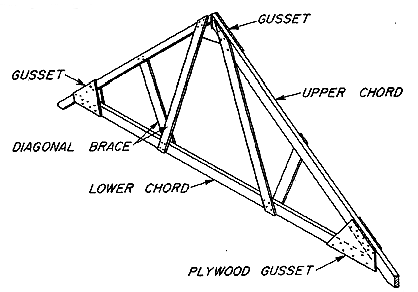
Gussets provide very strong connection details for large amount of force exerted, the upper and lower chords carry the tension and compression of the frames, the diagonal braces breakdown the forces into smaller force transmissions, hence, the light weight of the truss.

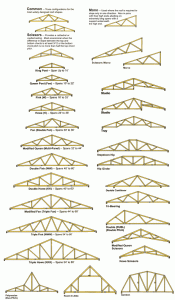
There are number of truss types and shapes. The names may not be critical, yet the shapes can be seen in various bridges or the track homes.


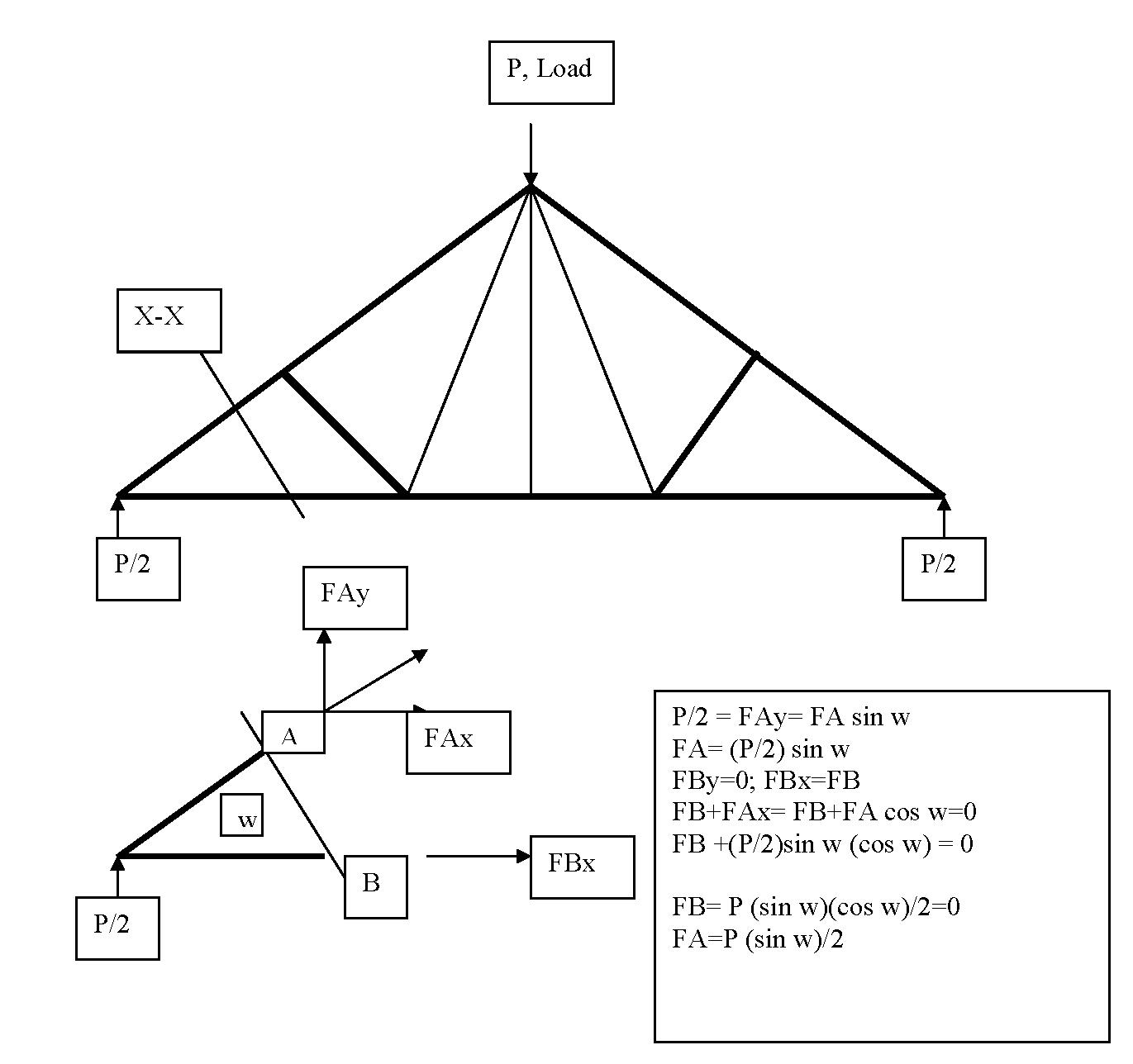
Truss Calculations is a series of vector equations that stem from the equilibrium equations. Vector sum of all forces and moment equations become foundations of finding all forces on each linkage. Of course complex  trusses would become a computer driven equations. Each force on linkage determines the strength required on that member and the connections required to satisfy the stability of the bridge.


Truss Definitions and Terms


These definitions and terms were floating in the internet and are great resource in identifying the terminology used by the truss tradesmen. Enjoy.

ADHESIVE

A substance capable of holding materials together by (sticky) surface attachment. In roof and floor Trusses the term includes cements, mucilage, and chemical and natural glues.

ALLOWABLE STRESS INCREASE

The calculated percentage increase in the stress permitted in a member, based on the length of time that the load causing the calculated stress acts on that member or assembly. The shorter the duration of the load, the higher the percent increase in allowable stress.

ANCHOR (ANCHORING)

The “tying” of a roof or wall component or system down or together to resist racking or lift. Walls can be “anchored” using foundation bolts, straps, and brackets; trusses using brackets, hangers and buckets.

APEX/PEAK

The high point on the Truss where the sloped chords meet. Same as PEAK.

ATTIC SCUTTLE

Framed in the field opening, most often with removable cover, providing access up into the attic.

AXIAL FORCE

The internal force compression or tension, acting along the length of each member. Axial Force is normally expressed in pounds or similar metric equivalent.

BALLOON FRAMING

A continuously framed gable wall where studs form one continuous piece from the floor to the roof. In the balloon method, the gable and the wall are framed all in one piece. Most houses have a rafter set on top of the wall to form the gable, and this is not a preferred method for wind resistance.

BEARING

Structural support, usually a wall, girder or beam, that is specified by the building designer to transmit Truss reaction loads downward to the building foundation. Point of Bearing, normally occurs at the top and/or bottom chord of the Truss.

BEARING AREA

The area, normally expressed in square inches, of the Truss member that is resting on the support.

BENDING MOMENT

The measure of the bending effect on a structural member due to forces acting perpendicular to the length of that member. The bending moment at a given point along a member equals the sum of all perpendicular forces, to either side of that point, times their corresponding distances from the point..

BOB-TAIL

A term used to describe a gable shaped Truss that is clipped at the end.

BOTTOM CHORD UPSET

Same as BUTT CUT

BOTTOM CHORD

A horizontal or inclined (scissors Truss) member that establishes the bottom edge of a Truss, usually carrying combined tension and bending stresses.

BOTTOM CHORD BEARING

Term used to describe the bearing condition of a parallel chord Truss that bears on its bottom chord.

BRIDGING

Wood or metal members that are fastened between Trusses and/or joists in an angled position, usually from the top on one to bottom of the next in a crisscross format, intended to spread and even the loading.

BIRDSMOUTH CUT

An angular notch on the bottom side at the end of a member to allow for an overhang past the outside of the wall onto which it is bearing.

BUILDING DESIGNER

Registered architect or registered engineer who is responsible for the technical design of the building.

BUILT-UP BEAM

A single unit composed of two wooden members having the same thickness, but not necessarily the same depth, which is designed to provide greater load-carrying capability as well as lower deflection.

BUILT-UP ROOF

Roofing composed of three to five layers of asphalt (normally installed on a level or near level roof.)

BUTT CUT

Slight vertical cut at outside edge of Truss bottom chord to ensure uniform nominal span and tight joints.

BUTT JOINT

The interface at which the ends of two members or other members meet in a square cut joint.

CAD

Computer Aided Design and drafting.

CAMBER

An upward curvature built into a Truss to compensate for deflection due to future loading conditions.

CANTILEVER

The part of a Truss that extends beyond its point of bearing/support, exclusive of overhang.

CENTER LINE SPAN

Theoretical span sometimes used to design Trusses.

CLEAR SPAN

Indicates the inside (interior) support/bearing-to-support/bearing dimensions. The unsupported horizontal distance between the inside edges of any two adjacent Truss supports. Not to be confused with SPAN.

CLINCHED NAIL

A nail selected and applied to be abnormally longer than the member that it is driven through and which is then bent back into the dimension of its excess length to strengthen the point of fastening.

CLIPPED (Clipped End)

Same as STUB or STUBBED TRUSS.

COLLAR BEAM

Wooden member connecting opposite roof rafters, often to resist lateral separation forces.

COLLAR TIE

A horizontal member placed between two rafters at a specific vertical distance above the very top plate line for the purpose of limiting outward thrust of the rafters.

COMMON TRUSS

An engineered component shaped so as to have a near equal pitch on both sides of a center peak. See the definition for TRUSS and FLOOR/FLAT TRUSS and click HERE for a detailed drawing of a common Truss.

COMPOSITE LUMBER (Structural, wood composites)

A family of materials that contain wood in whole and/or fiber form that is bound together with an adhesive as a substitute for dimension lumber.

COMPOUND CUT

A double cut made across the member width.

COMPRESSION

The force within a Truss member that has the effect of tending to apply shortening or compressing pressure that Truss member.

CONNECTOR

A mechanical device for securing two or more Trusses, components, pieces, parts, or members together, including anchors, buckets, straps, wall ties, and fasteners.

CONTRACT DOCUMENTS

Architectural and/or engineering drawings (plans), specifications, etc., used to produce a structure.

CONVENTIONAL FRAMING (Common Framing)

Framing with conventional joists, rafters and wall studs.

CREEP

Time and humidity and temperature caused deformation of a structural member(s) under constant load.

CRICKET

A ridge or drainage flume structure designed to divert roof framing. Generally found on the high sloped end of a chimney or the transition from one roof area to another.

CUTTING SHEETS (Cut Sheet)

A diagram and listing of lumber lengths and angles of cut for Truss web members and chords.

CUTTING BILL

See CUTTING SHEETS

DIRECT NAIL

To nail perpendicular to the member being nailed.

DROP TRUSS

A Truss designed to carry the same loading as other similar Trusses in a given structure, that is built to a given dimension shorter in overall height than the other Trusses in that run, designed to facilitate a double layer of roofing or other covering on the roof, while maintaining the same roof height throughout.

DRYWALL

Interior finish material sheet manufactured with gypsum (gypsum board).

FASCIA

The flat surface located at the outer end of a roof overhang or cantilever end

FEATHER CUT

A heel cut which has been made with a zero butt cut (a sawn member with a feathered edge).

FlREPLACE TRUSS

A Truss fabricated with a modified shape to allow clearance for the penetration of a chimney through the roof, whose loads are supported by a master (girder) Truss. (requires special engineering)

FLOOR/FLAT TRUSS

An engineered component shaped so as to be nearly rectangular. See the definition for TRUSS and ROOF TRUSS and click HERE for a detailed drawing of a flat Truss.

GABLE END FRAME TRUSS

A component manufactured to the profile of the mating Truss having vertical “in-plane” members fastened to the chords instead of diagonal web members. It is not a structural Truss and requires continuous support by a bearing wall or other load bearing element such as a beam along the bottom chord.

GABLE

The portion of the roof above the eave line of a double sloped (triangle shaped) roof.

GAMBREL

A roof having two slopes on each side, the lower slope usually steeper than the upper.

GIRDER

A beam of wood or steel used as the principal support of concentrated loads at points along its span.

GIRDER TRUSS

A Truss designed and engineered to carry heavy loads transmitted from other structural members bearing upon it. Often a multiple ply Truss.

HARDWARE

A computer and its peripherals (printer, plotter, etc.) other than the software.

HEADER

A conventionally framed wood girder located between stud, jack, tee, joist, rafter, or Truss openings.

HEEL JOINT

The point on a Truss where the top and bottom chords intersect.

HIP MASTER

Hip girder Truss designed to carry prefabricated roof jacks or common framing and hip corners.

HIP TRUSS

A component of a hip roof system of roof Trusses affording symmetry of architectural appearance. The eave line extends to the same level around all sides of the building eliminating the use of gable ends. Normally the off site manufacture of hip Truss parts aids in speed and quality of field construction.

HURRICANE STRAP or CLIP

Galvanized steel or stainless steel brackets, or thin metal strips used to strengthen “wood to wood” or “wood to concrete” connections. These straps may also be referred to as “hurricane clips.”

HYDRAULIC PRESS

A press consisting of a “C” clamp hydraulic cylinder; or an l-beam platen, or flat upper pressing platen, powered by hydraulic cylinders which are used to embed Truss connector plates into the wood.

INTERIOR BEARING

Term used to describe supports which are interior to two exterior supports.

JIG

The fixture which holds the Truss pieces in position until they are rigidly fastened with connectors.

JOINT

See PANEL POINT.

JOIST

A horizontal roof or floor framing member.

KICKER

Alternate expression for a Truss web member cantilever strut.

KNEE BRACE

A brace positioned between a column and Truss panel bearing points when Trusses are supported by columns lacking transverse bracing.

LADDER PANEL

Prefabricated wall panel fastened to the roof eave to create a sloped overhang.

LATERAL BRACING

Members placed and connected at right angles to a chord or web member of a Truss.

LET [the] TAILS RUN

When lumber making up the top chord of a roof Truss is not cut off to a specified length during manufacture, but rather is allowed to retain the random length of the piece of lumber used to fabricate that roof Truss. (Used for the purpose of meeting unspecified roof overhang requirements in the field.)

LEVEL RETURN

A Lumber filler placed horizontally from the end of an overhang tail returning back to the outside wall, to form a soffit that is level with the ground.

LSL – Laminated Strand Lumber

LSL uses timber from logs that are not large, strong, or straight enough to be of structural value in conventional wood products and is most often made fromAspenor Yellow Poplar. 75% of the tree is used. This engineered timber product marketed under the trade name TimberStrand®, this Laminated Strand Lumber (LSL) product, can be up to 60 feet long, 8 feet wide and over 6 inches thick. Beams, headers, decking are the most popular structural applications. As a substitute for traditional framing materials, costs may be higher than dimension lumber. We have, in our opinion only, some question as to its durability and its performance when exposed to moisture. Another possible disadvantage is that it is heavier than an equivalent amount of pine. For instance, in our testing, a 2 x 6, 16 feet in length, weighed approximately 29 pounds. An LSL functional equivalent weighed approximately 43 Pounds.

LVL Laminated Veneer Lumber

An engineered wood product created by layering selected dried and graded wood veneers with waterproof adhesive into blocks of material known as billets. This product is manufactured to disperse wood’s natural defects, such as knots, thus minimizing their effect on performance and stability. Before bonding, the grain of the component wood pieces making up each layer is placed at right angles to the grain of each other successive layer, adding strength and helping to prevent warpage in the finished product. These blocks are then sawn into popular lumber sizes. Marketed under the trade name Microllam®, LVL can be made with wood from smaller, faster-growing trees. Microllam products are typically available in various thicknesses and widths that can be wider in dimension that native grown lumber. LVL is also known as Structural Composite Lumber (SCL).

MEMBER

A load/stress carrying component of a roof Truss or floor (flat) Truss assembly.

MITER CUT

A single cut made at an angle to the length of a member.

MOE Modulus of Elasticity

An index of the stiffness of a the wood used to manufacture the Truss, applicable to the bending of a beam. Derived by measuring the elastic deformation of the wood as it is placed under stress, and then dividing the stress by the deformation..

MOMENT

A force that produces rotation of a member and
commensurate bending stresses.

MPCWT Metal Plate Connected Wood Truss

One of the methods used to fasten one or more members of of a Truss to others.

MSR Machine Stress Rated

Lumber that is graded for strength by testing equipment as opposed to visually inspected and rated.

NAIL-ON PLATE

Light-gauge steel Truss connector plates with or without pre-punched holes, through which nails are driven by hand or pneumatic means into the lumber.

NAILER (Scab)

A member fastened to another member by nails for reinforcement.

NATIONAL DESIGN SPECIFICATION (NDS) FOR WOOD CONSTRUCTION

A publication of the American Forest & Paper Association (AFPA) providing an appendix of lumber sizes, grades, species and allowable stresses for each.

NATIONAL DESIGN STANDARD FOR METAL PLATE CONNECTED WOOD TRUSS CONSTRUCTION

A publication of the Truss Plate Institute (TPI), outlining design and performance standards for Trusses to be designated as an ANSI/TPI approved standard product.

NET FREE VENTILATED AREA

Area required by building codes to allow for proper ventilation in enclosed constructed spaces.

NOMINAL SPAN

Horizontal distance between outside edges of the outermost supports.

NOTCH

A vertical and crosswise horizontal cut at the end of the chord, joist or rafter. See BIRDSMOUTH CUT.

ON CENTER (O. C.)

The measurement of spacing for structural members like Trusses, studs, rafters and joists in a building, from the center of one member to the center of the next.

ON EDGE

Vertical placement of a member’s wider edge.

ON THE FLAT

Horizontal placement of a member’s wide edge.

OUT-TO-OUT SPAN

Same as OVERALL SPAN

OUTRIGGER

A wood member nailed to a Truss to form a roof or balcony overhang beyond the wall line.

OVERALL SPAN

Outside of frame dimensions (not outside of veneer dimensions).

OVERHANG

The extension of the top chord of a Truss beyond the outside of the bearing support.

PCT

Parallel Chord Trusses such as a floor Truss. See example HERE.

P. E.

Designation abbreviation acronym for Licensed Registered Professional Engineer. See typical engineered roof Truss drawing HERE.

PANEL POINT

A point at which one or more web members intersect the top and/or bottom chord.

PANEL

The chord segment defined by two adjacent joints.

PANEL LENGTH

The distance between joints measured along the center line of the chord. See COMMON TRUSS DETAILS.

PEAK/APEX

The high point on the Truss where the sloped chords meet.

PENNY

Common nail length. Originally, nails were sold by “penny weight”, or price per hundred.

PIGGYBACK TRUSS

A Truss fabricated in two pieces, often consisting of a hip-profile Truss with a triangular cap fastened to be fastened to it in the field. This Truss design is mandated when shipping, manufacturing and/or architectural requirements or limitations are affected by overall Truss height.

PITCH

The incline angle of the roof/roof Truss and/or the ratio of the total rise of the roof to the total width of a given Truss system. For example, a 10 foot rise and a 30 foot total width yields a roof pitch of one third or 3 in one. Roof pitch is also known as the angle that the top chord makes with the lower chord such as a 20 pitch or a 45 pitch.

PLACING DRAWING/LAYOUT

Line drawing used to locate assumed placement positions of roof and floor Trusses by Truss fabricator.

PLUMB CUT

The end of the top chord is cut to to provide for a vertical (plumb) installation of fascia and rain gutter. The other common option is for the Truss tails to be SQUARE CUT.

PLY

The term given to one component Truss layer of a multiple-layer girder Truss.

PPSAPurdue Plane Structures Analyzer

A wood structures computer program developed atPurdueUniversity.

PRESS

A term used to describe the device used to embed Truss connector plates using compression.

PRESS-ON PLATE

A Truss connector manufactured with pre-formed teeth that are embedded by compression into the lumber, usually by an air, roller or hydraulic press.

PROFILE DRAWING

Sketches of Truss profiles used by mechanical engineer to determine where mechanical ducts, piping, etc., are to be located when installed in the finished construction.

PSL – Parallel Strand Lumber (PSL)

Also known by the trade name Parallam®, this product is made from the fiber on the outermost edges of the log which is often wasted or used in lesser-grade wood products. This patented process produces an engineered product that can be longer, thicker and stronger than timber cut from old growth native forests. PSL lumber is suitable for beams, columns, posts.

PURLIN

A horizontal member attached perpendicular to the Truss top chord for support of the roofing (i.e., corrugated roofing or plywood and shingles).

RACKING

A misshaping of a system, component or frame caused when horizontal loads applied to vertical members displace the frame from the designed triangular of rectangular configuration.

RAFTER

A sloping or pitched member in roof framing.

RAKE

The edge of a roof at the intersection of the gable.

RAKE OVERHANG PANEL

Prefabricated overhang panel that extends over the edge of the roof and is fastened to the gable end Truss, usually in the field.

REVIEWING ENGINEER

The term used to define the Truss engineer who checks and certifies the computer generated designs (CAD) of the Truss fabricator. The reviewing engineer may be an employee experienced in the design and testing of Trusses, and assigned this responsibility by a Truss plate manufacturer. He or she may also be an independent consultant experienced in the design, testing and performance of metal plate connected Trusses, and contracted by the Truss fabricator to perform such services.

RIDGE

The horizontal roof line made by the top surfaces of two sloping roof surfaces

RIDGE VENT

A prefabricated and formed metal strip placed along the apex of the roof to allow exhaust ventilation in combination with intake soffit or gable end ventilation.

RISE

The vertical distance from the bottom of the bottom chord to bottom side of the top chord.

ROLLER PRESS

A press that embeds connector plates by forcing them through the pressure two opposing rollers.

ROOF ASSEMBLY

A system designed to provide weather protection and resistance to design loads. The system consists of a roof covering and roof deck, or a single component serving as both the roof covering and roof deck. The roof assembly includes Trusses, or roof joists, the roof deck (often plywood,) a vapor ‘barrier,’ a thermal barrier, insulation and roof covering to keep out the heat or cold, rain and sun.

ROOF SCUTTLE

Framed opening in commercial roofs surrounded by a hinged door used for access to a commercial roof.

ROOF SHEATHING

Most commonly, the boards or sheet material fastened to the roof Trusses of roof rafters onto which the shingle or other roof covering, weather repelling material is laid.

ROOF TRUSS

The basic components of a roof Truss are the top and bottom chords and the web members. The top chords serve as roof rafters. The bottom chords act as ceiling joists. The web members run between the top and bottom chords. The Truss parts are usually made of 2 by 4 inch or 2 by 6 inch material and are fastened together with special metal connector/nail plates.

Roof Trusses are common and are designed and produced in a variety of shapes and sizes. The most commonly used roof Trusses, are in light-frame construction and are the king-post, the W-type, and the scissors Trusses. The most simple type of Truss used in frame construction is the king-post Truss. It is mainly used for spans up to 22 feet. The most widely used Truss in light-frame construction is the W-type Truss. The W-type Truss can be placed over spans up to 50 feet. The scissors, or cathedral Truss is used for buildings with sloping ceilings. Generally, the slope of the bottom chord equals one-half the slope of the top chord. It can be placed over spans up to 50 feet. see TRUSS.

SCUPPER

Provision for roof drainage pipe or duct.

SCL – Structural Composite Lumber

See LVL, above.

SET BACK

The distance from the outside edge of a bearing wall, exclusive of any wall veneer or non-structural covering, to the face of a hip master (girder) Truss.

SHEATHING

The material, most often plywood, covering the frame, walls and roof Trusses, on the exterior.

SHOP DRAWING

A drawing of roof Trusses prepared by a Truss fabricator from stock Truss engineering drawings, used to specify and fabricate Trusses. See typical engineered roof Truss drawing HERE.

SHOULDER JOINT

Same as BREAK POINT JOINT.

SISTER TRUSS (Joist)

Sistering is the popular term for the reinforcement of a Truss or joist by bolting, nailing, or otherwise attaching alongside the existing Truss or joist, another Truss or joist or reinforcing member. The second member is referred to as the ‘SISTER’ component.

SLIDER

Nominal two inch dimension lumber inserted between the top and bottom chords at the heel joint in the plane of the Truss to reinforce the top or bottom chord.

SLOPE

The incline angle of the roof described in inches of rise per foot of run (e.g., 4/12).

SLOPED SOFFIT

Any sloped overhang as compared to a level soffit return .

SOFFIT VENTS

Prefabricated soffit material with perforated or slotted openings created for the purpose of providing and enhancing intake roof ventilation.

SOFFIT

The underside of a roof overhang or Truss cantilever end. A soffit is normally ventilated.

SOFT STORY

A habitable room or rooms above a living, working or storage area such as garage, carport, or other area, that was not engineered to transmit shear and lateral forces appropriately. [If supporting walls and roof systems are not designed to handle loading forces, the entire structure may fail.]

SOFTWARE

Computer programs used to create management and engineering information, etc.

SPAN

The term generally used to communicate outside-to-outside or overall span of a Truss design. Also sometimes indicates the center line to centerline of bearing.

SPLICE POINT

The point at which two chord members are joined together to form a single member. It may occur at a panel point or between panel points.

SQUARE CUT

The tail end of the top chord that is cut so as to be perpendicular to the slope of the member at 90 degrees to the length of that member (most economical construction; see PLUMB CUT.)

STACKED CHORDS

The term most often used for agricultural Trusses when two members are positioned on top of each other to create a bottom chord.

STRINGER

Lumber industry terminology for lumber graded with respect to its strength in bending when loaded on the narrow dimension face. Used for cross members in floors or ceilings.

STRONGBACK

A nominal two inch thick framing member attached in the perpendicular to floor or roof Trusses; placed vertically against the vertical Truss web.

STUB TRUSS

Same as BOB TAILED TRUSS

STUDDED GABLE

Terminology for a gable end Truss built as a wall and resembling a stud wall built in the shape of a triangle. These chords are usually on the flat.

SUBSTRATE

The surface upon which the roofing membrane is placed.

SUPPORT (TRUSS SUPPORT)

The device, fixture or area designed to receive, hold and support the weight. live load and dead load, of each of the Truss members in the system.

T-BRACE

A brace consisting of nominal two inch dimension lumber nailed directly to the member requiring a brace, and with the width of the member perpendicular to the width of the brace.

THRUST

The term used to describe outward horizontal force.

TOE NAIL

A nail driven at an angle to fasten one member to another.

TOP CHORD BEARING

The bearing condition of a parallel or sloping chord Truss that bears on its top chord extension.

TOP PLATE

Framing consisting of two members on the flat that form the top of the exterior wood bearing walls of platform frame construction. Also, a single member on the flat in non-bearing wall construction.

TOP CHORD

An inclined or horizontal member that establishes the top surface member of a Truss.

TRIMMER

A conventionally framed wall member usually consisting of fastened multiple studs in a framed wall opening, used to carry header load reaction. The trimmer is the shorter member of the fabricated unit.

TRUSS (see Roof Truss)

An engineered pre-built component, designed to carry its own weight and added superimposed design loads, that most often functions as a structural support member. A Truss, most often made of wood, employs one or more triangles in its construction. Made from dimension lumber of various sizes, the chords and webs are most often connected together by the use of toothed connector plates which transfer the tensile and shear forces. Metal connector plates are stamped from galvanized steel sheet metal of varying grades and gauge thicknesses to provide different grip values. See COMMON TRUSS DETAILS.

TRUSS CLIP

A metal component designed to provide the structural connection of roof or floor Trusses to wall plates in order to facilitate resistance to wind uplift forces.

                        TRUSS FRAME (Truss-Frame)

The product of the structural connection of an upper Truss to a lower Truss by its integral wall members. View a technical drawing of a typical Truss-Frame component, HERE.

TRUSS LAYOUT

A technical drawing, produced by the Truss engineer, illustrating the precise inter-relation of Truss components and their final placement location on the final structural assembly. View sample HERE.

TRUSS SYSTEM

An assemblage of floor and/or roof Trusses, and/or Truss Frame components and Truss girders, together with all bracing, connections, and other structural elements and all spatial and locational criteria, that, in combination, function to support the dead, live and wind loads applicable to the roof of a structure, with respect to a Truss system for the roof, and/or the floor of a structure with respect to a Truss system for the floor. A Truss System does not include foundations, or any other structural support system.

UPLIFT

Wind, increased in speed, moving over a structure causing negative wind pressure (suction) to be placed inside an enclosed structure, creating uplift forces (upward pull) capable of blowing off the roof. Roofs are designed to resist only certain uplift caused when high winds travel over and across the roof.

WEBS/WEBBING

The term often given to the shorter members that join the top and bottom chords of a roof or floor Truss, which form triangular patterns in that Truss, usually carrying. transmitting tension or compression stresses, and are designed to prevent bending and/or flexing.


ARE 4.0 Structural Systems III Basics- Strength of Materials

 Comments Off on ARE 4.0 Structural Systems III Basics- Strength of Materials
Jul 062012
 

Basis of Strength of Materials: Stress, strain, strength,


Stresses

Stress is the same as pressure in compression or normal (pushing perpendicular, σ ), tension (pulling perpendicular, σ ), or shear (parallel or tangential,  τ  (tau),). The force applied on surface area. The stress on an object:

σ, tensile stress = F, Force on object/A, area
σ :  tensile stress,

F :  force on object

A:   cross-sectional area of the object

τ, tensile stress = F, Force on object/A, area

τ = the shear stress


Strain

When the object is pulled or pushed, the object is under strain. In case of pulling, the object elongates. The level of deformation and displacement is known by strain. Strain is the change in distance of elongation by the original distance.

Hooke’s Law– Hooke’s law of elasticity is an approximation that states that the extension of a spring is in direct proportion with the load added to it as long as this load does not exceed the elastic limit, Linear elasticity.

Young’s Modulus– material property that describes the stiffness of a elastic material.

E= tensile stress/tensile strain=       σ/e= (F/A0)/( ΔL/L0)

E is the Young’s modulus (modulus of elasticity)

F is the force applied to the object;

A0 is the original cross-sectional area through which the force is applied;

ΔL is the amount by which the length of the object changes;

L0 is the original length of the object.

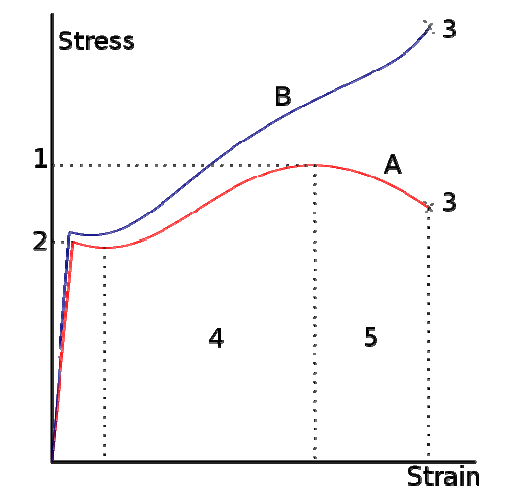
Stress vs. Strain curve typical of structural steel
1. Ultimate Strength:
The maximum stress a material can withstand when subjected to tension, compression or shearing. It is the maximum stress on the stress-strain curve.
2. Yield strength:
The stress at which material strain changes from elastic deformation to plastic deformation, causing it to deform permanently.
3. Rupture
4. Strain hardening region
5. Necking region.
A: Apparent (engineering) stress- Academic
B: Actual (true) stress

Breaking strength– The stress coordinate on the stress-strain curve at the point of rupture.

ARE 4.0 Structural Systems- II Who is a Structural Engineer?

 Comments Off on ARE 4.0 Structural Systems- II Who is a Structural Engineer?
Jul 062012
 

Who is a Structural Engineer?

Any element, component, structure, building, monument, equipment must be held from free fall, gravity, seismic, wind, hurricane, heights, tsunamis, man-made or natural disasters. Otherwise that element will fall.

Of course the famous Hammurabi’s building code states that if the building fails, and kills the son or daughter, the building owner can kill equivalent son or daughter of the designer.

When component is placed on 3rd floor of a building, the forces of the loads transfer from one member to another finally through columns; they are transferred to ground soil. This transfer requires a foundation. Foundation is like a shoe that permits a stable building. Eskimos wear shoes not to sink in snow in complete contrast to mountain hikers. The soil below the building is classified from A to F, from rock to very unstable soil. Foundation design is an art itself and correlates to geotechnical engineers’ science.

If you begin designing and accommodating the load on that level, basic components of structural design are as follows:

o Basic Theories: Very simple static and strength of materials can provide necessary knowledge to understand the concept, even design a system. More advanced theories get involved with micro issues, joints, connections, curves, more elaborate structures. However, one can break down any structure to simpler and through superposition method, one can provide complete understanding of the forces acting on the structure and each component.

o Modeling: Modeling a structure comprises of geometric shape, coordinates, segments, angles, and properties of material. The statistical quantities are loads, reactions, and stresses. The resultant deformations must be checked with allowed deformation; hence the material or material size is altered till full code compliance is met.

o Assumptions: The materials are homogenous, continuous, isotropic and act as spring (Hooke’s Law). The deformations do not alter the original geometry significantly. Since the loads applied are gradual, the superposition concept is valid. In superposition, one can apply each load independently and add the results. Therefore sum of effect of system of loads is equal to sum of effect of individual loads. Materials are constant and independent of time, therefore the system is assumed to be in static equilibrium.

o Type of loads:

• Single loads:

o concentrated load,

o moment applied by single load,

o uniformly distributed load,

o regularly varying load,

o irregularly varying load,

• Systems of loads:

o the combination of single loads,

o symmetrical loads,

o asymmetrical loads,

o cyclo symmetrical,

o cyclo antisymmetrical, and

o unsymmetrical loads.

Forces acting on members can be complex and number of equilibrium conditions required to solve these forces vary from one type of force to the other.

Coplanar force system or single concentrated load in two dimensional (2D) and three dimensional (3D) requires 3 and 3 equations, respectively.

Collinear force system where all the forces share same line of action in 2D and 3D require 1 and 1 equilibrium conditions, respectively.

Parallel forces where all forces are in parallel (both directions) in 2D and 3D require 2 and 3 equilibrium conditions, respectively.

General three dimensional forces where all forces are in one plane (all directions) in 2D and 3D require 3 and 3 equilibrium conditions, respectively.

o Effects of the loads: Loads produce reaction forces on members, the produce stresses on members, and they deform the structural members.

Effect of loads produce reactions on the connections.

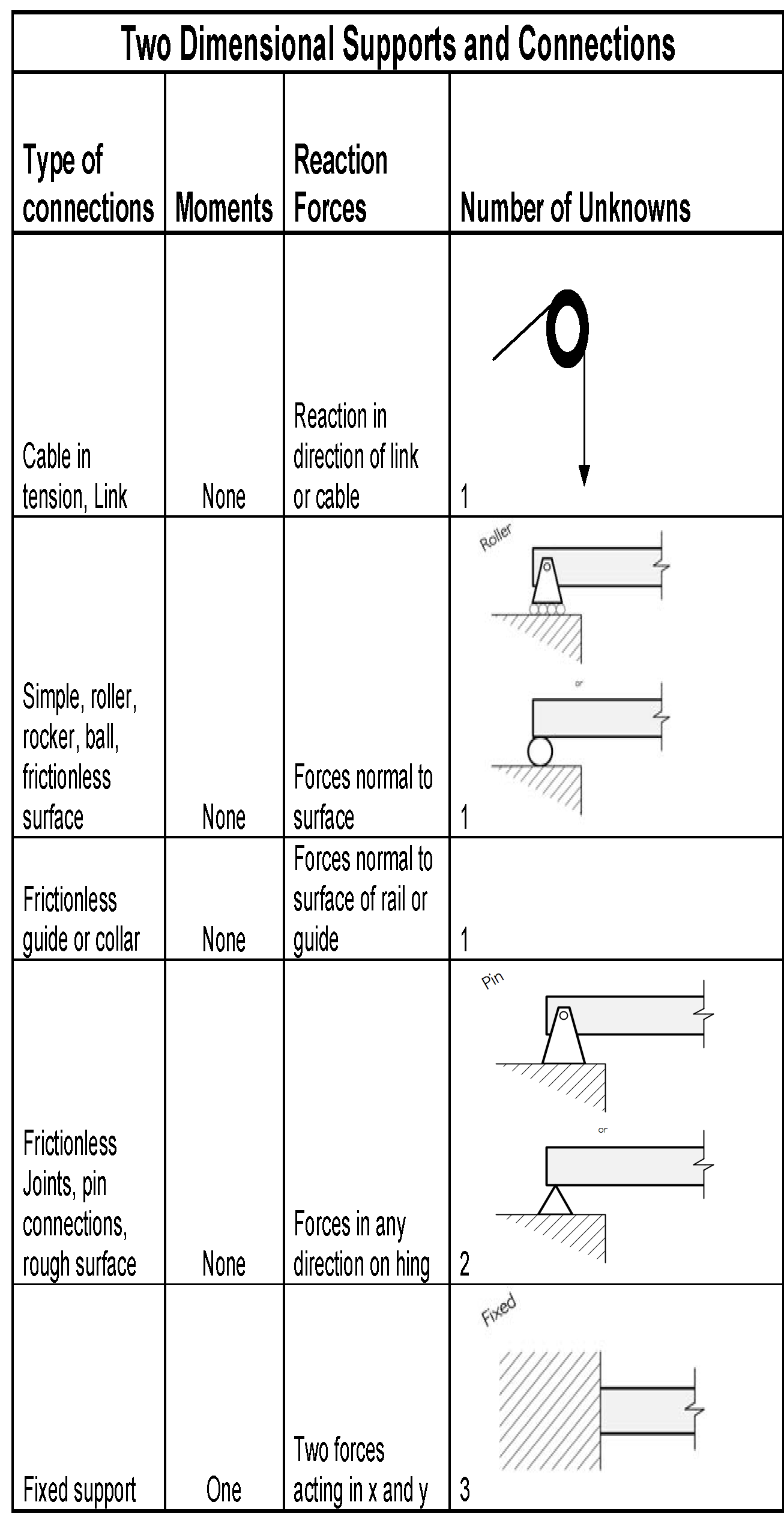
o Connections: Connections are movable hinged end, immovable hinged end, guided end, and rigidly fixed end. These connections carry moments and forces. If the member is free and able to move in a direction, reaction forces in that direction does not exist.

o Static equilibrium: Since the body under load is assumed to be in equilibrium, algebraic sum of all forces are zero, and sum of al moments at any point is zero. The vector form of these forces can be broken into any coordinate systems, ie. Cartesian, cylindrical, spherical coordinates.

o Stresses: Three stresses at center of any materials are: Normal forces, shear forces, and bending moments.

Procedure to perform a design:

One begins with the statement of the problem. A single or multiple or complex load is on top of the structure. Is the structure fit to support the component, say in Los Angeles. As the steps was described, first, you model the building in simple lines and provide all elements that support this component from top to bottom, to foundation, and to the characteristics of the soil.

For example, a battery rack is on 6th floor. The load of the battery rack is on several floor joists. Each floor joist must carry tributary load of the component. Each joist acts as a beam supported by sub-purlines. sub-purlines can be supported by beam, beams sit on columns, columns sit of foundation. The floor joist acts as beam. Beams designs are checked by insuring the can carry the stress, shear, and deflection. Floor joists transmit the load to sub-purlines. The sub-purlines act as uniformly distributed loads plus the contribution of the batteries as concentrated load. Using the superposition, the resulting parameters will be added. Same pattern must be devoted to the purlines, then to main beams. Finally the load is transferred to the column. Then the column is checked for stress, deflection, and buckling. The load on the column is transferred to the foundation. The soil has a capacity, for stable soil, worst case is 1000 lbs per square feet. If the load is 5000 lbs, the base of the foundation area is 5 square feet. There are other issues such as bending of the building and its impact on the soil is also defined.

What we did not discuss was materials, localities, and equations. Materials vary from steel, wood, concrete, timber fiber composites, and non-traditional materials such as bamboo. Location of the building is also critical. The wind, hurricane, earthquake, seaside, and mountain sites make quite difference.

There are two methods of calculations: LRFD and ASD.

Allowable stress Design or ASD is very simple. The allowable stress of the materials is reduced by a safety factor and then the load effects are compared to this reduced value.

Load and Resistance Factor Design or LRFD simply increases the load effects introduced by components and then it compares them to allowable material capacities. There are also resistance factors as multipliers on load effects that play a role in final design.

In eater cased, ASD where material capacity is reduced, or LRFD where the load effects are increased, the safety factors built in varies and has created two separate philosophies in structural engineering.

Capacity is the capability of the building to carry demand, the load. The C to D ratio is a common terminology used by structural engineer in evaluating existing buildings.

Equilibrium or Static

An object, i.e. a beam, a building is at equilibrium when sum of all forces in all directions (algebraic sum), moments and torques are at rest (or is zero) and are not moving, otherwise we would be in a mechanical engineering world called dynamics. Therefore, sum of all the (a) moments acting on the body, (b) vertical forces acting on the body, and (c) horizontal forces acting on the body must equal zero.

Example:

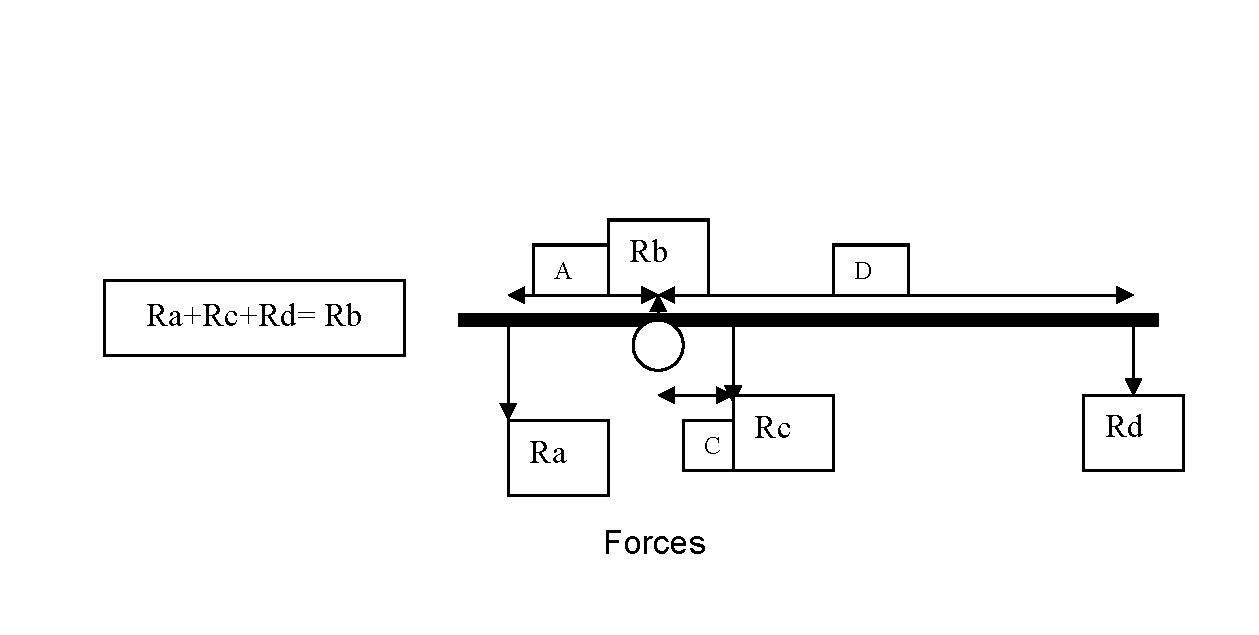
Assuming the beam’s weight is negligible, the forces in the vertical direction algebraically are zero. Summation of all vertical forces are

Forces

The unit of force is pounds, lb or # (Newton (SI), N) or thousand pounds, Kips (KiloNewtons, KN). The issue is the seesaw created is stable and not move? To respond to this question, one must take a moment.

Moment at any point is similar to the seesaw, the hammer, the wedge science class in 5th grade. Moment is the force time the arm distance. Arm distance is from the pivot to the position where the force is applied. This is the reason for monumental constructions of the pyramids, temples, and castles nearly 3 thousand years ago.

Moment at point b, or any other point, must be zero.

Therefore,

A.Rb= C.Rc+D.Rd

where the A, C, or D are arms or distances creating the torque.

Algebraic sum is the sum of components of vectors.

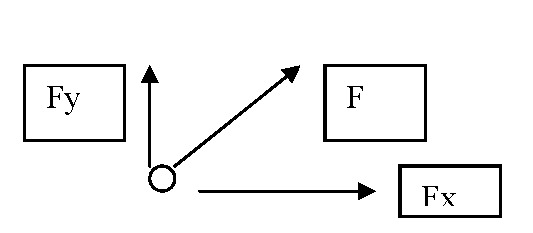
Force is divided into X component and y component. Applying the equilibrium, sum of all forces in x direction must be zero. Then apply this to y directions.

Please note that Pythagorean theorem and trigonometric sine and cosines can also be used in these calculations.

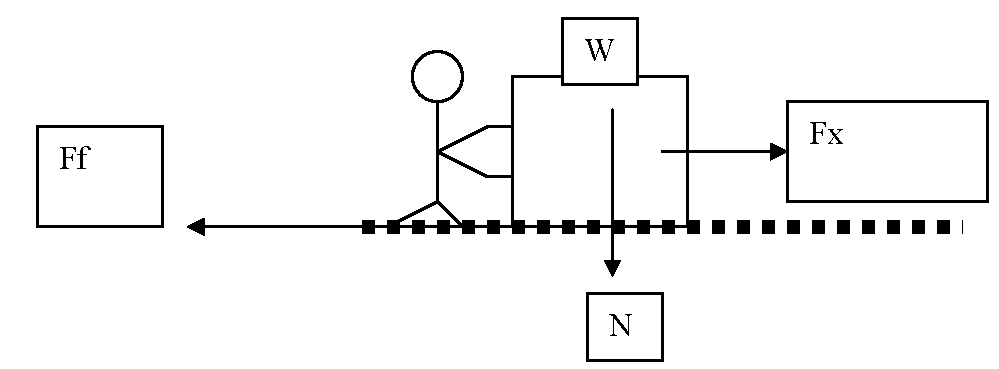
Any load can be converted into simple diagrams, namely, free body diagram, where vectors correspond to forces acting on a body. Fx is the force pushed by guy, Ff is the surface friction opposing the Fx, W is the gravity force applied on the box, and N is the normal force acting against the box by earth. (You can omit the picture of the guy in structural engineering).


ARE 4.0 Structural Systems Scores- Part I

 Comments Off on ARE 4.0 Structural Systems Scores- Part I
Jul 062012
 

Part I – ARE 4.0 a Structural Systems
July 2011 ARE® 4.0 a
RE
Content Areas

1. GENERAL STRUCTURES %38- %42 percent of scored
2. SEISMIC FORCES %28- %32 percent of scored
3. WIND FORCES %14- %17 percent of scored
4. LATERAL FORCES %13- %16 percent of scored

Vignette
STRUCTURAL LAYOUT
Design a schematic framing plan for a one story building With a mutli-level roof.

Effect of Cooking Oil on ABS, PVC, or CPVC

 Comments Off on Effect of Cooking Oil on ABS, PVC, or CPVC
Jun 202012
 

This engineer is struggling with identifying validity of following statement:

Is ABS bad with household grease?
Is PVC better with Grease?
Is CPVC better with Grease?

Have you heard of this reaction of ABS with Grease?
What are the reactions of grease and ABS?

I would like to initiate a dialogue among members.

However, I like to give you the lest and their content.

Answer up to now:

Chemical equation of vegetable oil
Fats and oils are biological substances called lipids (chemicals not soluble in water). Fats are solid at room temperature, while oils are liquid. Structural formula of fats and oils contain three ester functional groups. Fats and oils are esters of the tri-alcohol, glycerol (or glycerine) known as triglycerides or triacylglycerols. Source: http://scifun.chem.wisc.edu/chemweek/pdf/Fats&Oils.pdf

In Chemical Resistance Guide, thermoplastic Piping Systems, a 71 page guide by IPEX (http://www.gilsoneng.com/reference/ChemRes.pdf) the result of the chemical resistance of the vegetable oil is as follows:

Table 1
Chemical Resistance Chart of PVC, CPVC, and ABS to Vegetable Oil (by IPEX)

PVC 1 (60 F) 2 (104 F) – (140 F)
CPVC – (60 F) – (104 F) – (140 F)
ABS – (60 F) – (104 F) – (140 F)

RATINGS
1 High Resistance – All materials belonging to this class are completely or almost completely inert when used with the specified chemical at the specified concentration/ temperature levels.
2 Limited Resistance – All materials belonging in this class are partially attacked by the specified chemicals at the specified concentration/temperature levels. Life expectancy is thus shortened and it is recommended to use a higher safety factor than that adopted for Class 1 materials.
3 No Resistance – All materials in this class are severely attacked by the specified chemicals at the specified concentration/temperature levels. They should, therefore, not be used.
The absence of any class indication for any given materials, signifies the absence of data for such material(s) with respect to the specific chemical(s), temperature(s) and concentration(s).

Based on Data above PVC is not acceptable for temperatures at 104 degrees. CPC or ABS have not been tested or at least IPEX has not identified them. This Engineer also is having hard time responding to this question.

THERMOPLASTICS

ABS – (Acrylonitrile-Butadiene-Styrene) is ideal for residential and commercial sanitary (DWV) systems. With a working pressure up to 230 psi, ABS is also suitable for industrial applications such as mine slurry lines. Temperature range is -40°C (-40°F) to 82°C (180°F). ABS is resistant to a wide variety of materials ranging from sewage to household chemicals. It is joined by solvent cementing or threading.

PVC – (Polyvinyl Chloride) is the most frequently specified of all thermoplastic-piping materials. It has been used successfully for over 60 years. PVC is characterized by distinctive physical properties, and is resistant to corrosion and chemical attack by acids, alkalis, salt solutions and many other chemicals. It is attacked, however by polar solvents such as ketones and aromatics. Of the various types and grades of PVC used in plastic piping, Type 1, Grade 1 PVC (Cell Classifications 12454) conforming to ASTM D1784, is the most common. The maximum service temperature for PVC is 60°C (140°F) under pressure and 82°C (180°F) in drainage. With a design stress of 2,000 psi, PVC has the highest long-term hydrostatic strength 22.7°C (73°F) of any other major thermoplastic material used for piping. PVC piping is joined by solvent cementing, threading, flanging, grooving, gasketed joints, or mechanical joints.

CPVC – (Chlorinated PVC) (Cell Classification 23447), conforming to ASTM D 1784 has physical properties at 22.7°C (73°F) similar to those of PVC; its chemical resistance is similar to or generally better than that of PVC. With a design stress of 2,000 psi and maximum service temperature of 93.3°C (200°F), CPVC has proven to be an excellent piping material for hot corrosive liquids, hot and cold water distribution and similar applications above the temperature range of PVC. CPVC piping is joined by solvent cementing, threading, flanging or grooved joints.

PE – (Polyethylene) is a member of the polyolefin group. It is tough and flexible even at subfreezing temperatures. Pipes are generally formulated with only an antioxidant and some pigments, usually carbon black, to screen out ultraviolet radiation. ASTM D 1248 classifies three types. Type I low density, Type II medium density and Type III high density. Pipe is usually made from medium or high density for higher strength and hardness. PE is generally used for gas distribution, water lines and slurry lines.

PEX – (Cross-linked Polyethylene) is high density PE that undergoes a treatment to link single strands of PE through radical reactions between the molecules to form a dense network with up to 80% cross linking. The primary reason to crosslink PE is to raise the thermal stability of the material. Service temperatures are raised to 82°C (180°F). PEX pipe is primarily used for plumbing and radiant floor heating systems.

PP – (Polypropylene) is a lightweight polyolefin and generally high in chemical resistance. Although Type 1 polypropylene conforming to ASTM D2146 is slightly lower in physical properties than PVC, it is chemically resistant to organic solvents as well as acids and alkalis. Generally, polypropylene should not be used in contact with strong oxidizing acids, chlorinated

ARE Building Systems Divisions and Scores

 Comments Off on ARE Building Systems Divisions and Scores
May 072012
 

Building Systems- Intro

DIVISION STATEMENT
Evaluate, select, and integrate mechanical, electrical, and specialty systems in building design and construction.

Content Areas
1. CODES & REGULATIONS (5-8% Score)
2. ENVIRONMENTAL ISSUES (10-15% Score)
3. PLUMBING (10-15% Score)
4. HVAC (18-23% Score)
5. ELECTRICAL (10-15% Score)
6. LIGHTING (18-23% Score)
7. SPECIALTIES (14-19% Score)