POWERING THE CALL CENTER- High Availability

 Comments Off on POWERING THE CALL CENTER- High Availability
Oct 042011
 

This article is targeted at the user who will become involved with development of the power systems plan for a call center of greater than 50-production seats and addresses only new construction. In a retrofit, the basics are nearly the same however there are additional parameters to work through with the local Power Company modifying the existing building to suit and the building owner(s) requirements. It should be noted that high rise building do not make good call centers since they create structural, power and mechanical challenges with placement of support systems. The basics are the same for the smaller call centers, but there are other power support options that are less expensive but not addressed in this article.

There are really two power systems within a call center. The first power system deals with the commercial power which is defined and controlled by the National Electrical Code (NEC). The other power system is the Isolated Ground (IG) – Uninterruptible Power System (UPS). The IG-UPS system is the basic support for production seats and communications.

Power Needs:

The first and most important step is to identify a Professional Electrical Engineer (PE-E Electrical) to assist in the building power design. This becomes very important if you are contemplating the use of a low-rise raised floor. The PE-E must have experience with the specific raised floor product selected for the project. There are specific design consideration with low-rise floors from both a power and communications perspective. The use of raised floor, coupled with a zone wiring system, will provide maximum flexibility in the future reconfiguration of the operating area floor space. Plug and play technology makes reconfiguration of workstations possible.

The next step is to resolve the total number of production seats and any other critical operational floor locations that must be protected by the UPS system. Experience has proven that in call center environments that due to floor space costs, workstation levels can max out at 100 square feet of space per person. This space includes isles, and is calculated based on all space which is not required (i.e. Restrooms, Lunch Room, etc.) to support the employee. If you have working with a raised floor environment with zone wiring, the one person per 100 square feet of space method should be applied. This will generate a higher power requirement, but it will allow you more flexibility in future growth and reconfiguration options as the call center environment matures.

Now that we have the number of locations to be supported, we can move on to the next step. It is important to assist the PE-E by providing the required information about the equipment deployment for each production seat location. You can look at the back of the equipment and find the power supply information that is on the information tag attached to the electronics. This estimate will, in most cases, be on the high side, because the numbers are stated in the theoretical maximum load. This maximum will only be reached if the machine is fully loaded. Normally this not the case with a piece of equipment used in a production seat environment.

The PE will perform calculations to help estimate the Volt*Amp/1000 load (KVA) for each seat location and the total requirement for the power load. The next recommendation will be the number of workstations per power circuit. History has proven that no more than four workstations per circuit should be used due to the possibility of additional equipment requirements in workstations where specific work-related responsibilities require a personal fax machine, printer, etc. Equipment suppliers will provide the volt and amp loads and the BTU/Hour information for the Communication Rooms. This information is needed by both the Mechanical Engineer and Electrical Engineer to complete the calculation required for the power and air conditioning requirements.

The PE-E is now in a position to size electrical system for supporting equipment. You will be tasked with determining how long the UPS is to support the load and if power conditioning is required. Why do you need power conditioning? Power conditioning removes all the power fluctuations. This is as much a financial consideration as it is functional performance issue. The longer the time the system needs to perform the higher the cost. If you have a generator as part of the supporting equipment you can reduce the time required. In a 24/7 environment, the recommended minimum time that a UPS runs should be 18 minutes which is the estimated safe shut down time for all equipment with a walking time allowance from the farthest point in the building to the server room even when a generator is available. Generators don’t always start on demand so allow some trouble shooting time to resolve any unforeseen issues. It is essential for the generator to continuously be tested and operational.

To size the generator requires identifying the additional equipment that will need to be supported. In most cases this will include air conditioner(s) for the operating floor and the communication room(s), emergency lighting, and other functions that support your production seats. Based on the current condition of the commercial power grid and the possibility for “rolling blackouts”, it is strongly recommend that all call centers have local generating systems.

The decisions that are made in the early phase of construction will directly effect the operational cost as the call center expands, or modifies in configuration. Power changes can be the most traumatic because they may require a shut down of the support equipment. Therefore, it is best to consider some form of raised flooring with an under floor zone wiring system developed for both power and communications as the operation emerges.

Mechanical Needs: of Call Centers

A call center is consists of four types of mechanical requirements. They are divided into the general office area, consisting of the conference rooms, single office spaces, and similar spaces. The open call center area with tens of cubicles is the second type of area. The main computer equipment room is the third type of space. And fourth is the communication room, which normally has limited computers and only voice and data switching equipment. Each is thermodynamically different and must be treated different.

Mechanical air conditioning and cooling of space is calculated based on the amount of heat generated within space or penetrating through the outer skin of the building. The interior component of the space is usually the same regardless of the geographical location of the building or the orientation of the building or the type of structural or architectural esthetics of the building. In addition, the call center type buildings are no longer considered to have many architectural elements (glasses, etc.). The exterior skin of the building and the orientation or the location of the building effects the air conditioning load requirements.

The cooling requirements of the interior depends on the heat contribution of the following: the human bodies (nominally 500 Btu/hr per person), the computers (nameplate rating of CPU computer 500 watts, the monitors range from 250 to 350 watts), the printers (idle mode nominally 400 watts to in use value of 720 watts (HP-IV)), the copiers (nominally 1200 watts when in use), and lighting (typically 1.5 to 2.0 watts per square feet). The above nominal values differ with equipment. In an unscientific study, the actual power consumption of a computer is less than the nameplate values given. Unfortunately, there are no technically published data for actual power consumption of a computer station, or a group of stations. Till, the technical publication is published, mechanical engineer must design for the maximum possible power consumption. Cooling requirements for specialty rooms such as computer facilities with tens of heat generating equipment or break room facilities with many vending machines is the summation of heat dissipation of all equipment.

One Watt is 3.4 Btu/hr (thermal British unit per hour). One air conditioning tonnage is 12,000 Btu/hr with 400 cfm (cubic feet per minute) of air.

The exterior shell of the building is divided into Conduction, and radiation. The convection contribution is mostly mixed with conduction calculations. The conduction is the amount of heat gradually penetrating through the skin (walls or roof or doors or windows). The “R” value of walls or roofs is the amount of resistance to this heat travel. The amount of heat passing through the skin is the product of the area of the skin and the temperature difference on two sides of the skin divided by the R- Value. The outer skin temperature is the worst ambient temperature generally at solar noon (12:00 noon adjusting for the daylight saving) on July 22nd (the longest day of the year) depending on the location (New York, Denver, Dallas, or Los Angeles). The inner skin (indoor) temperature is typically set at 75 degrees.

Radiation contribution (the amount of light passing through glazing) also depends on exact location of the building. However, building orientation is much larger factor. Typically, 200 Btu/hr per square feet for the west facing, 160 Btu/hr per square feet for south facing, the 100 Btu/hr per square feet for east facing, and 30 Btu/hr. per square feet for north facing glazing. East facing has been lowered intentionally, since the peak hours of east facing is 9:00 to 10:00 am and does not cause major comfort issues. Tinted glass, fins, overhangs, curtains, vertical blinds, and dual pane glazing reduce the radiation factors.

Within the computer rooms and the communication rooms or dedicated printer/copier rooms, the humidity control also becomes an important factor for proper operations. Many of the printer manufacturers or server suppliers will void the company warranty if the humidity within space is not controlled. Special dedicated computer air conditioning units facilitate all of the cooling and humidity requirements. Liebert, Compuair, Data aire are some of the examples of the manufacturers. Due to critical support conditions of the computer rooms, a secondary air conditioning unit is highly recommended as back-up unit.

There are many types of air conditioning units. Depending on the type of building, size of project, structural issues, and several other parameters, the mechanical engineer must select the best possible systems for the space. Controls of such space must be also well suited for the space given.

It is highly recommended that the building selected must provide the maximum flexibility for the mechanical engineer. High rises are nearly the worst selection for a call center and a one story building with strong roof structural support and high ceiling is the most ideal space for call center. It is very difficult to provide approximate tonnage for any call center. It must be calculated only on case by case basis.

For a given shell structure building, the cost of electrical and mechanical system can be near 60% of the tenant improvement cost and that includes the entire furniture system in the construction cost. Therefore the mechanical and electrical system of the building are the most significant component of the total budget.

Finally, the heating, ventilating, and air-conditioning unit designed and installed will be for a well coordinated building with very high heat load, sophisticated control system, high maintenance system, and a most essential component of maintaining healthy environment for the equipment and the human occupants.

Communications Room Needs:

The communications room will follow the same basic procedure. Yes, some environments require multiple communications room as in the case of a high rise building and large floor plate area’s. The number of communications rooms will be dictated by both Power and Digital Communications requirements.

Based on the digital communications requirements the recommendation of at least one Communications Room per floor; additional rooms are recommended when:

The usable floor area to be served is greater than 10,000 ft^2.

• There should be one Communications Room per 10,000 ft^2 of usable floor space.
• The rule-of-thumb estimates usable floor space at 75% of total floor space.
• The length of horizontal distribution cable required to reach the work area is greater than 328′ total cable feet. This is a measure of the cable required to go from the cube to the termination in the Communications Room. It is recommend that the maximum should be about 175 ft. This will allow you to run faster as speeds increase in the future.

When there are multiple Communications Rooms, it is recommend these closets be interconnected with at least one conduit (trade size 4) or equivalent for copper risers and one for fiber risers. The number and size of cables, which run between the rooms, will dictate the quantity of conduits. It is recommend that all digital communications be carried on fiber risers.

Assuming one work area per 100 ft^2 the Communications Rooms should be sized as follows:

Usable Closet
Floor Size
Area Feet

1,000 – 10,000 10 X 11
800 – 8,000 10 X 9
500 – 5,000 10 X 7

Note: Room size will finally be dictated by the communications cable design and the total amount of equipment installed.

In most cases the communications rooms should be centrally located in the floor plate area they support. You will need to start with the list of the equipment to be installed in each communications room. One or more communications room per floor given the square footage of the floor plate, the wire runs not exceeding 150 to 200 square feet, etc.
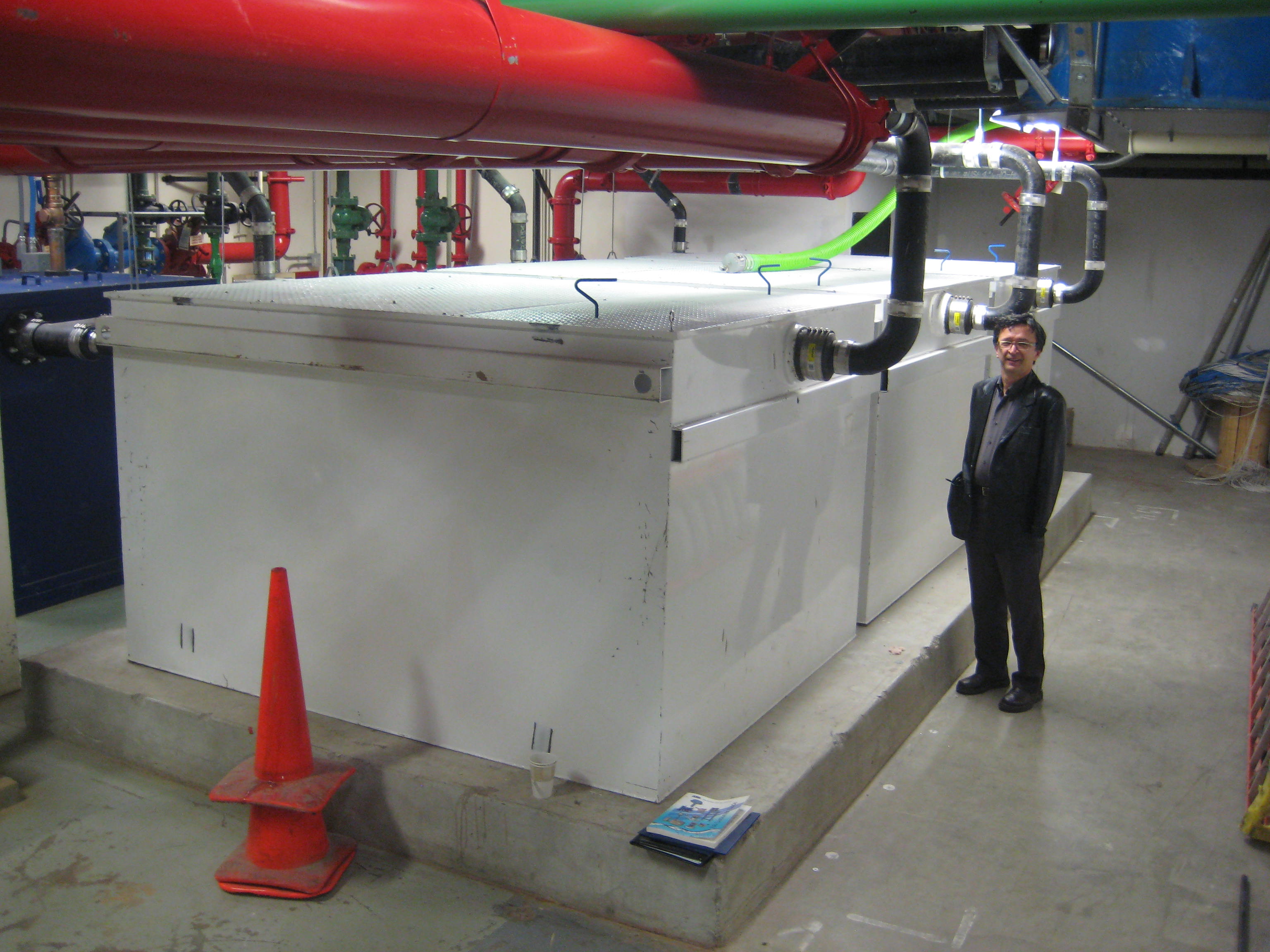
Anatomy of ANSI A117.1 (ADA) and ICC Codes:

 Comments Off on Anatomy of ANSI A117.1 (ADA) and ICC Codes:
Oct 022011
 

Anatomy of ANSI A117.1 and ICC Codes:
ANSI ADA requirement is very clear in its statement that:
“A117.1: Water supplies and drainpipes shall be insulated …”.
Once you identify the key word “insulation” and define it:
Insulation: the action of separating a conductor from conducting bodies by means of nonconductors so as to prevent transfer of electricity, heat, or sound; also : the state resulting from such action (Source: Merriam-Webster’s Medical Dictionary)
By referring to basic heat transfer books (i.e. JP Holman, Heat Transfer, McGraw Hill, 1986), insulation can further be defined scientifically:
Insulation Material, R value = (Te-Ti)/q/A, Deg F. ft sq. hr/Btu
where
Te-Ti= Temperature difference between Exterior to Interior, Deg F
q/A= Rate of heat loss/ Cross Sectional Area, Btu/hr/ft sq
International Code Council in IBC Chapter 7: Section 719 addresses the presence of insulation as a component within a building. The summary of related sections are as follows:
THERMAL- AND SOUND-INSULATING MATERIALS
719.1 General. Insulating materials, …. Where flame spread index… with ASTM E84.
Exceptions:
1. Fiberboard insulation … Chapter 23
2. Foam Plastic insulation … Chapter 26
3. Duct and pipe insulation and duct and pipe covering and lining in plenums … IMC
719.3 Exposed installation. Insulating materials … flame spread index no more than 25 and a smoke-developed index of not more than 450.
719.7 Insulation and covering on pipe and tubing. … flame spread index no more than 25 and a smoke-developed index of not more than 450.
Chapter 8
INTERIOR FINISHES
803.8 Insulation. Thermal and acoustical insulation shall comply with section 719.
Chapter 26
Plastics
2602.1 DEFINITIONS. FOAM PLASTIC INSULATION. … density less than 20 pcf.
2604.1 General. Plastic materials installed as interior finish or trim shall comply with Chapter 8. … shall also meet the flame spread index requirements for interior finish in accordance with Chapter 8.
2604.2 Interior trim. …
2604.2.4. Flame spread. The flame spread index shall not exceed 75 where tested in accordance with ASTM E 84. …
Chapter 8
INTERIOR FINISHES
806.5 Interior trim. Interior trim is not and does not include the
definition of the insulation.
Clearly when one observe the interrelationships of all sections, from definition
of insulation in section 719, acoustical thermal/insulation in chapter 8,
plastics in Chapter 26, and interior finishes section 805.6, the clear
definition of the tern insulation and scientific definitions become major safety
element of the building. Especially this fact is amplified when nearly all
barrier protection devices are plastic in industry and exposed to any unwanted
or deliberate fire situations.
This Engineer, Dr. K. Nour “Saum”,PE authored this brief and was retained by
Plumberex Specialty Products, Inc..

Green Act on Grocery Market Stores

 Comments Off on Green Act on Grocery Market Stores
Oct 022011
 

Given the state of economy, any movement towards am efficient operation translates to blessings for the operators of that business. The reduction of the load burdens on the machinery, more efficient motors, and sustainable and green products are some of the movements and innovations that are now available for the operators.

A supermarket is a multilevel operations with many high use energy components. Due to the high energy demands, supermarket operations become an excellent candidate for fine tuning for high efficient facility. While older aged facilities will benefit the most, the younger facilities will enjoy all the benefits of the new technologies and smart systems that have been implemented and utilized in the past years.

Recently, most supermarkets built were based on early and aged prototypes that were designed by engineers and architects. The design fee structure as well as the construction cost budget allocated does not permit any new innovations that in the long run are financially beneficial as well being very efficient for the building. Introduction of technology to the building produces fear into one group and rattles the traditionalists’ image in opposing such new elements into the design.

One of the benefits of the supermarket is very high attention given by the energy industry, academia, utility companies, as well as the government bodies. It was not very difficult to identify papers, articles, documents, doctoral thesis, innovation papers, and many pother related journals dedicated to high energy efficient supermarket. However, given the statements above, the today’s supermarket does not enjoy the benefits of these noted works.

In this report, this Engineer proposes to review all possibilities of the savings within the supermarket, review the energy profiles of the store, review the nearly all of the energy seeking equipment (i.e. motors, air conditioning, lights, …), and to augment the energy used by the renewable energy sources or on-site energy productions.

By review of the Figure 1, the example of the energy distribution of a typical grocery store is given. Grocery stores in the U.S. use an average of 52.5 kilowatt-hours (kWh) of electricity and 38,000 Btu of natural gas per square foot annually. A 100,000 square feet store will equate to 5,250,000 Kilowatt-hours (kWh) or 3.8 billion Btu of natural gas. Energy costs account for 15 percent of a grocery store’s operating budget. Because grocery stores’ profit margins are so thin—on the order of 1 percent—every dollar in energy savings is equivalent to increasing sales by $59. Any percentage of savings will greatly benefit the owners and consequently the greenhouse effects.

To tackle this issue, there are several mechanisms available for analysis:
• To attack the items that are considered as “Low Hanging Fruits”

The “Low Hanging Fruits” or LHFs are those that easily are accessible equipment, the ratio of KW to dollar savings are very high. In addition, the impact of the modifications to the operations are minimal to none.
Many grocery stores can benefit from low- or no-cost energy expenditure reductions. Some of the examples of the LHF’s are:
Turning Things Off
It’s the simplest of ideas. Remember that every 1,000 kWh you save by turning things off equals $100 off your utility bill. (This assumes average electricity costs of 10 cents/kWh.)
Plugged-in devices. Computers, cash registers, bar-code readers, deli scales, and deli cooking equipment should be shut off when not in use. “Smart” power strips with built-in occupancy sensors are available to shut off plugged-in devices when no users are present.
Lights. Turn off lights when they’re not in use. Occupancy sensors can help; a less-expensive alternative is to train staff to ensure that switches are off when the lights aren’t needed. Stores that are open all night may want to install dual-level switching for overhead lights, allowing some fixtures to be turned off during low-traffic hours.
Turning Things Down
Some equipment cannot be turned off entirely, but turning it down to minimum levels where possible can save energy.
HVAC temperature setbacks. During closed hours, turn temperature settings down in warming seasons and up in cooling seasons.
Special-use rooms. Make sure that HVAC settings in warehouses, stockrooms, offices, and other special-use rooms are at minimum settings.

Cleaning and Maintenance
Check the economizer. Many air-conditioning systems use a dampered vent called an economizer to draw in cool outside air when it is available to reduce the need for mechanically cooled air. The linkage on the damper, if not regularly checked, can seize up or break. An economizer that’s stuck in the fully open position can add as much as 50 percent to a building’s annual energy bill by allowing hot air in during the air-conditioning season and cold air in during the heating season. Have a licensed technician calibrate the controls; check, clean, and lubricate your economizer’s linkage about once a year; and make repairs if necessary.
Check air-conditioning temperatures. With a thermometer, check the temperature of the return air going to your air conditioner. Then check the temperature of the air coming out of the register nearest the air-conditioning unit. If the temperature difference is less than 14° Fahrenheit (F) or more than 22°F, have a licensed technician inspect your air-conditioning unit.
Change filters. Change air-conditioner filters every month—more often if you’re located next to a highway or construction site where the air is much dirtier.
Check cabinet panels. On a quarterly basis, make sure that the panels to your rooftop air-conditioning unit are fully attached, that all of their screws are in place, and that the gaskets are intact so no chilled air leaks out of the cabinet. Such leaks can cost $100 per year per rooftop unit in wasted energy.
Clean condenser coils. Check condenser coils quarterly for any debris, natural or otherwise, that has collected there, and remove it. At the beginning and end of the cooling season, thoroughly wash the coils.
Clean evaporator coils. The buildup of dirt and ice on evaporator coils slows down the rate of heat transfer and causes the refrigeration system to use more energy to maintain the same temperature.
Check for airflow. Hold your hand up to air registers to ensure that airflow is adequate. If there is little airflow or dirt and dust are found at the register, have a technician inspect your unit and duct work.
Check the refrigerant charge. Incorrect refrigerant charge can compromise refrigeration equipment efficiency by 5 to 20 percent and raise the risk of early component failure. Have a licensed technician check the refrigerant charge of all refrigerated equipment annually.
Check refrigerated cases for air leakage. Every month, inspect and replace any worn seals and gaskets on the doors and inspect the door closers for proper operation.
Check temperature settings on refrigerated systems. Energy is wasted if refrigeration temperature settings drift too low. Periodically check to verify that the appropriate temperature settings are specified.
Add strip curtains to walk-ins. Simply adding strip curtains to the doors of a 240-square-foot walk-in refrigerator reduced the unit’s energy consumption by 3,730 kWh per year—about 9 percent of total consumption!
Replace incandescent lightbulbs with screw-in compact fluorescent lamps (CFLs). Whenever an incandescent lightbulb burns out in a fixture that is on for longer than two hours per day, replace it with a CFL. They are three times more energy efficient than incandescent bulbs, last 10 times longer, and—because they give off one-third as much waste heat—increase the efficiency of walk-in refrigerators and freezers. Specify low-temperature-rated CFLs for freezer applications.
Install occupancy sensors in walk-ins. By replacing light switches with low-temperature occupancy sensors, you’ll reduce lighting energy consumption by about half.
• Ages equipment are the next candidates to be considered
There are many reasons that this category becomes a good candidate. The high maintenance cost for the upkeep of the equipment, the lack of efficiency, as well as low lack of controls and monitoring of the equipment give very high reasons for replacements. Naturally through time, the new equipment go through major transformations, namely: either new energy regulations and new state laws, higher efficient equipment, added components for measurement and verifications (M & V), interactive monitoring, and digital signatures on the machines. The hidden maintenance costs, time spent by the workforce to babysit the equipment, the frequent downtime of the machinery and lack of income from such machinery are added reasons for this category.
• To review the innovations on high energy usage categories- Refrigeration
By observing the energy distribution pie in Figure 1, the highest to smallest energy consuming components are Refrigeration, offices, heating, cooling, lighting, etc. Therefore it is natural to identify all of the available resources to review these in such order. In addition to the above stated issues (i.e. complete change-out), there are number of M & V devices that can increase the efficiency of the system by 25%. 25% of 36% is 9% of the total usage within the building and is considered to be significant. However, there are number of parameters to be considered before moving through this route. The office equipment can be the interior lighting, heating and cooling systems, as well as their general office equipment. Through the EPA’s energy star program, there can be very giood start. Demand use operation controls, as well as identifying the habits and office personnel can be beneficial. The Lighting, heating, and cooling for the entire space can be individually categorized and discussed later.
Some of the examples of activities for improving refrigeration efficiency are:

Optimize Refrigeration
The optimization of refrigeration systems can reduce energy use by 24 percent relative to standard practice. The following measures yield the largest savings.
Floating head pressure. Taking advantage of lower ambient temperatures to reduce refrigerant temperatures is a form of free cooling. One approach is to allow the pressure of the vapor coming out of the compressor (the “head pressure”) to float—that is, to drop with reduced ambient temperatures. This requires an expansion valve capable of operating at lower pressures and flow rates, and such valves are now commercially available. In addition, refrigerant pressures must be kept high enough to avoid “flashing”—the unwanted vaporization of refrigerant. In one field test, operating a system with floating head pressure reduced annual electricity costs by 4.9 percent relative to operating with fixed head pressure.
Ambient and mechanical subcooling. Reducing the temperature of the liquid refrigerant below its condensation temperature is called subcooling. This can be done either by using ambient air or water to remove heat from the liquid refrigerant (ambient subcooling) or by using an additional refrigeration system (mechanical subcooling). Colder refrigerant means either more cooling per pound of refrigerant delivered to the display case or shorter compressor run times because less refrigerant is needed, both of which can decrease energy use. Ambient subcooling is often more cost-effective than mechanical subcooling because it requires less equipment.
Evaporative condensers. Most condensers in grocery stores are air-cooled, but it is also possible to use evaporative condensers, which are cooled by water spraying over the condensing coils. Evaporative condensers are more energy efficient than their air-cooled counterparts, but they do have a notable disadvantage: They require a water supply, which often means increased maintenance due to freezing, clogging, and mineral buildup. Evaporative condensers may be cost-effective in drier climates, but the added maintenance may make them unattractive in other climates.
Heat-recovery systems. Heat-recovery systems are available that capture waste heat from refrigerators to make hot water for use in the store. A 7.5-horsepower compressor can heat all of the hot water a midsize supermarket would use in its kitchen cleanup and bathroom sinks. Often, enough waste heat is also available to supply hot water coils for space heating in cold weather.
Display case shields. Aluminum display-case shields can reduce refrigeration load from the display case by 8 percent when applied overnight and by 40 percent when applied over a 24-hour holiday, relative to the load present without the shield. Products are kept colder when the shields are attached and remain colder for several hours after the shields are removed.
Evaporator-fan motors. Replacing existing shaded pole motors on evaporator fans with electrically commutated motors will reduce the energy consumption of refrigerator and freezer cases by 40 to 70 percent. Drop-in replacement designs have made this retrofit relatively simple for a technician to perform. Additionally, most evaporator-fan motors in walk-ins run continuously even though full airflow is usually required only about half the time. Consider introducing advanced controls that slow the fans when full-speed operation is unnecessary. Annual cost savings can result in about a one-year payback for the total cost.
Anti-sweat heaters. The latest anti-sweat heater controls sense humidity in the store’s ambient air and reduce the operation of their heaters in low-humidity conditions. They promise significant savings and quick payback, and they are relatively easy to install.
“Smart” defrost controllers. When installed in walk-in freezers, a smart defrost controller monitors several variables and optimizes the number of daily defrost cycles. Adding these kits can save hundreds of dollars a year, depending on the size of the freezer.
Consider Desiccant Dehumidification
In humid climates, much of the energy used in air conditioning goes to removing moisture from the air. Desiccant dehumidification can be a cost-effective solution for removing this moisture because it uses natural gas instead of electricity. In some cases, air-conditioning equipment can be smaller sized because it is only used to cool dry air.
Focus on refrigeration for big energy savings
The key to conserving energy in any business is knowing which operations consume the most energy. Like other businesses, lighting, heating and cooling and office equipment are a part of supermarkets’ energy use profile. Typically, however, grocery stores use more energy for refrigeration than the other operations put together.
Several measures can reduce the cost of refrigeration. Some are inexpensive while others require a significant investment, but conservation in this area gives a double hit on savings. Cold air from refrigerated cases and walk-in coolers enters the store, increasing the energy needed to heat the building in winter so reducing refrigeration also translates to lower heat bills.
On the no-cost side, Energy Star offers the following refrigeration tips to help grocery stores save money and energy on refrigeration needs:
• Keep doors shut—Repeated fluctuations in temperature will damage food quality and cost money.
• Check temperature settings—If settings are lower than necessary, the system may be wasting energy. The most common recommended settings are between 14 degrees below freezing and 8 degrees below freezing Fahrenheit for freezers and between 35 degrees and 38 degrees Fahrenheit for refrigerators.
• Clean cooling and evaporator coils—Dirt accumulation impairs heat transfer and lowers the efficiency and capacity of refrigerators. Keep evaporator coils free of ice build-up. Don’t forget the condenser coils, usually located on the building roof. Also, do not put a sprinkler on the roof to help cool the condenser coil, as domestic water contains mineral that can damage the coil.
• Check door seals—Tight seals and properly closing doors prevent warm air from entering the unit, which reduces cooling energy and prevents frost buildup. If a dollar bill slides easily into the seal, have the seal adjusted.
• Maintain equipment—Performing scheduled maintenance on any type of business equipment improves an operation’s efficiency.
Simple changes prevent cooling losses
Taking common sense to the next level provides more refrigeration efficiency. Stores that do not operate 24 hours a day can save energy on their open-air cases by installing curtains to cover the case openings. This acts like a closed door on the case, sealing in the cold and significantly reducing the load on the refrigeration system.
When products are being moved to and from walk-in coolers, the doors are often left open for extended periods of time. Cold air flows into the store, creating a load on the heating system, while the refrigeration system tries to cool the space the heating system is warming up.
A simple solution is to add strip curtains. This minimizes the loss of cooling from the walk-in while the door remains open for staff and equipment to pass through. Since cold air sinks, the curtains should reach the floor to keep cold air from escaping at the bottom.
Automatic doors offer a more complete, but more expensive solution. The strip curtains should still be used with doors that close and open by a pull cord or button.
Lighting fixtures in older refrigerated cases can be big energy consumers. Many use high output ballasts because they work better at colder temperatures than regular ballasts. Try the new “cold weather” electronic ballasts that can be used with the lower wattage T-8 bulbs, measuring one inch in diameter, and 5/8-inch T-5 bulbs. These lower wattage bulbs often put out more and better quality light than older ones, and add less heat to the case. This savings potential could be as high as 10 percent.
System controls adjust energy use for operating conditions
Environmental conditions—ambient temperature, humidity, etc.—affect most electrical equipment and this is especially true of refrigerator units. Adding a variety of controller units to different system components can yield significant energy savings.
Refrigeration systems work by compressing and expanding a refrigerant. The pressure a compressor uses to develop is directly related to horsepower. So, the lower the pressure needed to cool to the desired temperature, the less energy used.
Most head pressure controls, as these are called, are set to a level that remains fixed regardless of the outside temperature. However, the system should not have to work as hard in cool weather since the condenser—the coil on the roof that cools the refrigerant—is in cooler air. By installing floating head pressure controls, the controller can automatically adjust downward as conditions allow for energy savings of 3 to 10 percent.
The condenser, which exhausts heat from the refrigeration system, and the evaporators that cool the walk-in cooler and product cases use electric motor-powered fans to cool the fins. High-efficiency motors do the same work with less energy. In the case of the evaporator, using less energy to move air generates less heat for the refrigerator to cool. Changing to energy-efficient motors can save between 5 and 13 percent per year.
Evaporator fans that operate continuously to mix cold air and distribute it to products also generate heat. Several manufacturers make controllers that reduce the fan motor’s speed to minimize the heat when cooling is not needed. The fan continues running at a reduced speed until the thermostat calls for cooling. Then, it speeds up to blow air over the evaporator coils and cool the space. Contact the Power Line for more information about this equipment.
Many freezer cases have glass doors, which are excellent at saving energy and maintaining product quality. However, when the door is opened, moisture from the warmer store air condenses on the glass fogging it, so the product can’t be seen. This is called sweating, and door manufacturers solve this by installing anti-sweat heaters to keep the door glass warm.
Glass fogs less during winter months and in dryer climates where the moisture content of the air is lower. Adjustable anti-sweat heater controls detect these differences in the environment and pulse the heaters on and off to save between 6 and 20 percent, depending on conditions. These controllers are relatively easy to install and can be adjusted automatically. In some cases, the refrigeration system may already have this feature and it just needs to be hooked up.

• The Heating and Cooling systems have their share of advances.
The use of building management systems, high level of monitoring and controls, presence of very high efficient units have produced tangible benefits to the supermarket. The word “comfort” can be redefined by the level of interaction of the operators of the building and full satisfaction of the occupants. The EER efficiency ratings from 7 to 8 have been elevated to 12 and 13, straight, 25% more efficient units. Leakage through ductwork account up to 10% of the energy losses, and the unclean plenums, and other factors minimize the comfort level for the store. Although environmental issues are not discussed in this article, there are direct secondary benefits of heating and cooling energy upgrades.
• Lighting has benefited the most in the efficiency and technology.
The lighting industry has benefited the most in the energy advancement. With very efficient ballasts, lamps, innovations on LED, reflective enclosures, motion sensors, on demand use, and intelligent timers the impact on savings are veru visible to the users and financial officers. Most important note is the synergy of other energyt useage with lighting. When the lighting loads within store is reduced, the heat created by the light fixture is also reduced, hence the air conditioning loads will reduce and frequency of their usage is reduced.
Some of the examples of improving the building lighting are:
Upgrade to More Efficient Lighting
Lighting is critical to creating ambiance and making merchandise attractive to shoppers. High-quality lighting design can reduce energy bills and drive sales. If your facility uses T12 fluorescent lamps, relamping with high-performance T8 lamps and electronic ballasts can reduce your lighting energy consumption by 35 percent. Adding specular reflectors and new lenses and reducing the number of lamps can double the savings. Occupancy sensors or timers can add further savings in storerooms and other staff-only areas. Paybacks of one to three years are common.
Changing refrigerated display-case lighting to light-emitting diode (LED) light strips saves energy and has been shown to appeal to customers significantly more than linear fluorescent lamps. LEDs are more than 40 percent more efficient than T8 lamps, provide a more-even light distribution, are dimmable, and have a long lifetime. In stores that remain opened 24 hours a day, LEDs can be tied to occupancy sensors so the display cases are only illuminated when customers are present. The waste heat from LEDs can be dissipated outside the case, something fluorescent lighting can’t do, resulting in reduced refrigeration energy: For every watt in reduced energy consumption, there is an additional 0.48-watt savings from reduced refrigeration demands.
Grocery stores with high ceilings might want to consider using T5 lamps and indirect fixtures to boost both lighting quality and lighting efficiency. T5 lamps are far more energy efficient and offer better light quality than either the high-intensity discharge lights or the older-style T12 and T8 linear fluorescent lamps typically found in high-ceilinged stores.

Use Smart Lighting Design in Parking Lots
Most parking lots are designed with far more lighting than the 1 foot-candle or lower average that the Illuminating Engineering Society of North America’s Lighting Handbook (2000) recommends. Using lower-wattage bulbs can actually increase the safety of your lot—an overlit lot can be dangerous to drivers if their eyes cannot adjust quickly enough in the transition from highly lit to dark areas. When designing lighting for a new parking lot, consider low-wattage metal halide lamps in fixtures that direct the light downward, rather than high-pressure sodium lamps. Even with a lower wattage, a grocery store could safely use fewer lamps if this choice is made. Metal halide is less efficient than high-pressure sodium in conventional terms, but it puts out more light in the blue part of the spectrum, which turns out to be easier for our eyes to see under low-light conditions.
LED lighting has emerged as an even more efficient parking lot option than high-intensity lighting. However, because the Energy Star program does not currently include parking lots in its list of acceptable LED applications and because LEDs’ high initial costs result in long payback periods, be sure to conduct a thorough analysis before you commit to LED lighting for your parking lot.
• Cooking and Ventilation are other components used in supermarkets.
The hood industry and cooking equipment have gone through some innovations. Presence of on-demand use sensors, variable frequency drive, very simple skirts on cooking hood covers (LHF item) as well as commissioning of the systems to design standads will greatly enhance the systems.

• Water Heating are considered as near 100% efficient units.
Theme is “older the water heater, the lower the water heater efficiency”. Water heaters are now near 100% efficiency with 10 years warranty. Once one combines this with other heat recovery systems from (the refrigeration systems) for the feed water, the water heating becomes extremely attractive proposal.

• On Site Energy Productions is now vital and viable.
Although solar has some set backs, they are great tools and energy source to reduce the peak demand charges by the utilities. Coupled with small cogen plant, the energy usage will decrease to only natural current baseline of the building usage.

In culmination of the above bulletins, there are many activities that can take place and create a very efficient and low energy use buildings.
The first activity for this Engineer is the Energy Audit of the site. An energy audit analyzes and evaluates existing energy-use practices with an eye toward cost savings.

Individual audits can vary, but they are likely to cover the following items:
• Baseline energy-use profile: Hopefully 15 minute energy use data

• Building envelope improvements- Possible energy leaks
• Heating, ventilation, and air-conditioning systems
o Retrofitting and replacement
o Improved schedules
o Improved placement of thermostats and air sensors
o Improved computer programs
• Lighting
o Installation of timers and automatic sensors
o Replacement of light fixtures and bulbs
o Improved scheduling
• Plumbing improvements
o Identification of leaks
o Improved pipe insulation
• Overall design of a company’s energy management program
• On Site Power generation or Co-generation-Solar power feasibility studies

Grease Interceptor Codes – IV

 Comments Off on Grease Interceptor Codes – IV
Oct 022011
 

Codes
The two Nationally recognized codes of IPC and UPC as well as local amendments greatly differ from each other.

IPC 2006 addresses the Grease Interceptors in section 1003.3. It is relatively short and lacks to totality required to meet the variations in restaurants, and many circumstances that engineer will face. This confusion will lead into many interpretations across the board between jurisdictions, building owners, restaurant operators, the builders, and engineers.

The fixtures that must be on grease collection system are pot sinks, pre-rinse sinks, soup kettles or similar, wok stations, floor drains or floor sinks serving the kettles, automatic hood wash unit, dishwashers without pre-rinse sinks. Only equipments with fat and oil content will be allowed into the system. Equipment with solid content (i.e. food grinders) shall have additional solid interceptor prior to grease interceptor and emulsifiers, chemicals, enzymes, and bacteria shall not discharge into food grinders.

Grease interceptor devices must meet PDI G101, ASME A112.14.3 or A112.14.4. Their capacity is based on total flow rate through in gpm versus the grease retention capacity in pounds. Technically the equation is :

Grease retention capacity (lbs) = 2 x Total flo-through rating (gpm)

To insure the rating for a designed grease interceptor, flow control restrictions must be provided with venting to terminate minimum 6” avove the flood rim level.

Automatic grease removal devices are allowed for one or multiple fixtures with proper access and to meet the guidelines of the manufacturer.

UPC 2006 has extensively modified their code from earlier versions. For years, the grease interceptors have been addressed in appendix of the code. An appendix to the code is only code when the jurisdiction adopts the appendix. In 2006, UPC transferred the section to the body of code and clearly addressed many of the concerns. These concerns were from many directions, from the end users, from an old code equation that many times did not meet the reality of the establishment, from environmentalists, and from jurisdictions.

The new code has seriously resolved many of the old issues concerning the sizes of the grease interceptors. With certain restrictions by the local authorities, only these types are allowed in those jurisdictions. For a small pretzel shop, the minimum of 750 gallons was very large. The lack of production of waste grease into the interceptor would cause secondary heath concerns, bacteria growth, fungi, and erosion of the inner liner of the concrete structure.

In short, many diverse groups saw a major overhaul is necessary. Initially group of engineers and later were joined by many manufacturers’ representative to address the issue of Fat, Oil, Grease (FOG). At the end of all discussion, the following provides the brief review of the code.

In addition, the entire equation was based on meal counts which were extremely susceptible to any interpretations available on the actual meal. The number of meals was based on seat count which did not include the catering or carryout business. In addition, the meal was not defined in pretzel shops or in a bakery. Now with the advent of the new code, the flow rate of each fixture is the primary gage for the sizing of the interceptor. The new code sizing charts are great improvement.

Many health departments do not allow the installations of any type of grease removal system within food preparation areas and must prove the cleaning and maintenance is readily accessible. Like IPC similar kitchen equipment must use the grease piping system: scullery sinks, pots and pan sinks, soup kettles, and floor drains with grease containing exposure. It is believed that the presence of the dishwasher in this section (1014.3.2.1) must be erroneous since it conflicts with section 1014.1.3.

The operators are on notice that a period maintenance is part of the code enforcement, the jurisdiction will use legal means to insure the maintenance. (best management practice- BMP). Unlike IPC, no food waste disposal, commercial food waste disposers, or dishwasher is allowed within the interceptor systems,

Like IPC, hydromechanical grease interceptors (HGI) are now permitted in this code. A non-adjustable flow controller tpo meet the designed flow rate will be installed with a vented interceptor and vent (downstream of unit) shall terminate to roof.

Based on full open channel flow the sizing chart is based on Demabd Flow Unit and HGI flow rate in GPM: The rates are shown in (2% slope pipe) DFU: HGI (GPM).

8:20; 10:25; 13:35; 20:50; 35:75; 172:100; 216:150; 342:200; 428:250; 576:350; 720:500

The total capacity in gallons of the HGI must not exceed 2.5x gpm flow rate or maximum total capacity of 50 gpm flow rate shall be 125 gallons.

The foundation of the gravity grease interceptors (GGI) was based on basic open channel flow and retention/filtration laws. Use the fixture demand units for water consumption as main axes of calculations. The FDU then provides the gpm flow and hence pipe sizing. Based on ½ full circular flow(Mohinder Nayyar Piping Handbook, 3rd Edition, 1992), and FDU units, the input to the grease interceptors was identified. Based on Metcalf & Eddy, Inc. Small and Decentralized Wastewater Management Systems, 3rd Ed. 1998), the most efficient retention time was determined to be 30 minimum. The retention time based on the flow determines the volume, depth, and length of the interceptor. The separation of the grease interceptor is primary based on variations in density. The semi-solid particles settle in bottom of tank, the grease remains in the initial compartment and the water with heavier density escapes in the bottom of the baffle.

The final GGI sizing was simple and substantially less than the previouse code

(DFU:Volume (gallons)) 2% slope pipe

8:500; 21:750; 35:1000; 90:1250; 172:1500;
216:2000; 307:2500; 342:3000; 428:4000;
576:5000; 720:7500; 2112:10,000; 2640:15,000

Not in code: Full extended UPC Table

FDU Flow Pipe Slope Volume
Gpm Inch gallons

8 10 2” 2% 500 gal
21 – – – 750 gal
35 29 3” 2% 1,000 gal
90 – – – 1,250 gal
172 44 4” 1% 1,500 gal
216 62 4” 2% 2,000 gal
307 2,500 gal
342 80 5” 1% 3,000 gal
428 120 5” 2% 4,000 gal

The wrong interceptor sizing works in two directions: both the under sizing as well as over sizing. In the case of under sizing the flow of the mixed fluid is high and does not allow the segregation and isolation time required, and thus, the grease is still mixed and will escape the chamber. In the case of over sizing, the grease gets collected and the call for cleaning increment is prolonged. As the time of retention increases, the organic compound invite bacteria and enzymes, and with the natural sulfides within the water system, the sulfites and created and further transformation to sulfuric acid which transforms the grease interceptor into a chemical reactor. The by products of these event simply corrode and reduce the life expectancy of the interceptor and efficiency. In addition, the grease removal truck have only certain definite volume, and there are no assurance that during the operations proper number of trucks at right time interval clean the interceptor, and in many cases the solid residues are always present and will never be removed.

Types of Grease Interceptors
There are two types of retentions based on their size.
• Large units or grease interceptors that collect the grease globally and work on basic gravity and retention process.
• This multi baffled chamber uses the density gradient of the grease and non-grease fluid, and separates the grease.
• This is based on the fixture count and their loading rate.
• These units are from 250 gallons to 15,000 gallons.
• Their materials can be fiber glass, concrete with lining, and stainless steel. Concrete units are far more fabricated and sold in the country.
• The inner liner provides corrosion barrier to all concrete in contact with the fluids.
• These units are buried underground. The fiber glass or stainless steel can be both underground or above ground. (Proset unit)
• The fiber glass or the stainless steel above ground units are favorite of the high rises or the parking garages below the restaurant within malls.
• In one instance, in a hill side situation, the soil and structure could not be placed underground. (Getty Center)
• The unit was to disturb the existing sloped hill side. The light weight of the fiberglass units in shallow water tables may cause floatation and buoyancy issues. It is recommended to provide additional weight to the unit (“dead-Man’s weight”) to insure proper installation. In many historic and tourist towns, the placement of these units is problematic.
• Extremely small backyards or zero lot line prohibits the use of these units underground outside. (San Francisco, Newport Beach, etc.)
• In addition, there are many circumstances that the substructure pipe work or power/low voltage work has created a cluster that is impossible to burry such mass and volume.
• Smaller size of these units is a size of small compact car and it elongates towards a bus (3000 gallons).
• Once again, these units cannot be too far from the restaurant and for colder climate, the electrical heating jacket is recommended. These units need venting and in many times, pre or post inspection boxes maybe required.

In addition, the entire equation was based on meal counts which were extremely susceptible to any interpretations available on the actual meal. The number of meals was based on seat count which did not include the catering or carryout business. In addition, the meal was not defined in pretzel shops or in a bakery. Now with the advent of the new code, the flow rate of each fixture is the primary gage for the sizing of the interceptor. The new code sizing charts are great improvement.

The smaller grease retention units are called traps. The traps either work passively in the same manner as the interceptors or they “hydro mechanically” extract grease. The unit sizing is very critical. Improper sizing will cause the grease to bypass the original intended mechanical extraction. Based on their small volume, they are limited in number of fixtures. There are health departments that will not allow these units, and if they accept, they must not be in the food prep or cooking area. The physics and science of all hydro mechanical devices are based on the higher surface tension and viscosity of the grease. Different cooking oil has different surface tensions and given the viscosity dependency on the indoor temperature, a calibration of the hydro mechanical system is due.

Restaurants are either operated from small family owned business to franchisee owner to the main corporate headquarter owning the restaurant. In all three there are variations in standard practices (operations and Practices manual). The lack of training, frequent replacement of employees, the disgrental employees, and lack of finances within the store causes the frequent cleaning of the traps to be delayed or forgotten, therefore creating major health issues. The more sophisticated the unit is, the higher cost of maintenance, reduced grease extraction, and less cleaning of the unit in time. This becomes very true in small family operated restaurants.

Placement of these units is also a major challenge. If this unit collects multiple fixtures, the unit must be underground. However, the floor of the restaurants is not conducive for burial of the grease trap. If it is allowed, the superintendent of the construction site must be aware of all issues. In some cases, the floor below is a parking garage. Therefore it is very difficult to install. If the units are for Point-of-Use and serve a single fixture, then the challenge is identifying proper placement of the unit. Generally under the three compartment sink, these units fit only if the sink bowl is shallow and the legs are higher than normal (6”). Even then, there are challenges in placing the pipes without intruding to other space. The study and experience of all engineers concentrated in the restaurant design is needed to evaluate the new hydro-mechanical grease extraction devices. Unfortunately, most engineers are only exposed to sales brochures and the sales skills of the manufacturer’s representative.

For a new shopping center it is best to place the future grease sewer piping for future grease interceptor location till the perspective restaurant tenant moves in. The nominal size not to be greater than 1500 gallons. One does not want to have large interceptors with small unit restaurants.

Grease Collection- III

 Comments Off on Grease Collection- III
Oct 022011
 

Grease Collection and Retention
• Based on the Clean Water Act and
• closures of the public beaches due to the sewer contamination of the beaches,
• several court cases have forced an overhaul of the practices of the restaurant facilities and eateries in southern California.
• Financial cost of the street public sewer cleaning process,
• major clog sewage treatment plant,
• or a beach closure is enormous.

The overflow of sewer into the public storm drain system is a paramount issue to avoid in any public works. The presence of grease particulates in the sewer system has greatly increased this probability. Although the best operation management practices within restaurants are in place, they are hard to monitor and comply. Lack of staffing is the primary cause. However, the Authority Having Jurisdictions will have a great opportunity in scrutinizing the engineered plans and to insure proper design practices are in place. Along with many other inspection, the designed plans are part of the environmentally correct restaurant, or food manufacturing plant.

A typical sewage treatment plant contains several processes. Various forms of basic screening, filtration, settling chambers, clarifiers, and chemical additives are some of the processes. Grease particulates at lower temperature coagulate and become a clogging mechanism in nearly every one of the stages of sewage treatment. The organic properties of the grease particles make an excellent meal for bug growth within the plant, hence increasing the BOD levels and increasing the cost of the treatment plant. Some estimates are up to 80 cents per gallon of treatment. Sudden massive dosage of food in the sewage treatment plant induces the bugs to eat the food at rapid rate and not reproduce enough for the next cycle. At this point, plant operator must introduce cultured bugs into the system for its natural process. Each Jar of bugs cost near $400.00.

Case history: In Orange County California, Grand Jury (2000-2001) reviewed 35 wastewater facilities with near 12,000 miles of sewer lines and near 7000 restaurants. The purpose of the review was the possible sanitary sewer overflow events resulting in beach closures. The following was the result of that review:
“Restaurant generally dispose of cooking grease/oil in the following three ways:
1. Grease traps- These are small devices hooked directly to the outgoing drains of sinks and dishwashers and are located inside the restaurant. Beause they hold small quantities of captured grease, these traps must be emptied and cleaned on a regular basis, and the grease properly discarded to prevent grease overflow into the sewer system.
2. Grease Interceptors- Interceptors are large underground devices usually located out the restaurant and connected to the restaurant’s outgoing sewer drainage system. These large tanks have heavy man-hole-like covers that are difficult to access for inspection. When full, they must be emptied and cleaned by private waste pickup and disposal companies.
3. Large covered barrels- Barrels in which higher quality cooking grease is placed are kept covered and then collected by commercial companies who sell it for industrial reuse. These barrels are placed outside the restaurant. They are easily accessible and are usually not a contributing factor to the problem, unless they are accidentally spilled and the contents enter sewer or storm drain”

Case History: Cookie factory in San Marcos California: The night shift cleaning of the facility would cause a large magnitude of sugar and sweets to flood the treatment plant in short period of time. The enzyme eating bugs would feed themselves to extinction. Therefore, the facility had to replenish the bugs at $400.00 per jar ($1000.00 per night) to renew the bugs life cycle within the facility. Solution a large 10,000 gallon dilution plant was used for the interceptor to accept the dilute the night shift sewage with day sewage, and hence the bugs life would be in equilibrium.

Localized retention and capture of the grease at the source (the restaurants, factories, etc.) greatly enhances the entire system, and the cost becomes a component of the restaurant cost of operation as oppose to the general public tax payer supporting the maintenance of sewer piping and infra structures or the treatment plant.

Unfortunately, within all counties across the country, there is no consensus on what kitchen equipment should be grease sewer piping. There is some equipment that is not in question, i.e. the prep sink, the scullery sink. However, the verdict is not unanimous on several others. The controversial ones are the floor drains, the mop sink, the dishwasher, and the sink with the garbage disposal. The theory is that any water/sewer mixture that contains solid particles or detergent chemicals must not go to interceptor/trap. The detergent by its nature creates bubbles and attracts the grease particles and through lighter weight and its buoyancy, which bypasses the retention chamber freely. The solid particles clog the system and create havoc within the chamber. Floor drain and floor sinks have never been reasoned within many jurisdictions.

One of the properties of the grease is the viscosity variations with temperature as well as the phase change of liquid to solid at room or lower temperature. This issue amplifies in colder climate or long distance traveling of the grease sewer piping. The change in viscosity and thus its solidification increase the chance of roto rooter house calls. Burial of the piping below the freeze point of the finished floor plus providing electric heating jackets for the piping greatly enhances the flow of the grease sewer piping as well insures the uniformity in the viscosity throughout the year.

The most culprit piece of equipment in the kitchen has been identifies as the pre-rinse prior to the dishwasher. This accounts for nearly high percent of the grease content of the kitchen. Most other fixtures are incidental grease load and are not frequent. A local treatment or collection of grease to the pre-rinse may solve overall grease collection process.

Water Heaters, Gas Piping, Water Softner- III

 Comments Off on Water Heaters, Gas Piping, Water Softner- III
Oct 022011
 

Water Heaters
Water heater selection and type of water heater is a major issue. This is a major topic of discussion on its own. However, it must be noted that placement of the water heater is not an easy task in many of the facilities described. High efficient water heaters with no conventional flue ducts are the most favorable water heaters. First, the efficiency of the water heater pays back the added cost of the unit. Second, the flexibility in the PVC (for flue discharge) piping is absolutely the selling point of this type of water heater. The efficiency of the water heater reduces from 98% to 94% as the length of the PVC piping increases, and yet it still is nearly 14% more efficient than conventional water heaters (i.e. American Water Heater, Polaris). The size of the water heater is generally questioned by the health department.
Many Engineers and many health departments do not use the insta-hots or the tank-less water heaters in the restaurants. In both cases, the volume of the water heater required will not suffice and multiple units are required. In addition, the interior heater piping heat exchanger chamber of the tank-less is very small and in bad water quality areas, the maintenance of the tank becomes extremely frequent. In addition, the tank-less water heaters do not work with water circulation piping. They are wall hung and thus the food service designer saves valuable floor space. This debate will not end with this report.

Water softeners
The water softener discussion raises multi-tier issues. Availability of the space is the number one issue. Second, the water quality must be measured before omitting this component of the design. Last, the presence of dishwasher or use of clear glass, or china in the restaurant becomes a decisive factor. In a tightly spaced kitchen facility, lack of proper space for placement, maintenance and contiguous chemical feed of the water treatment equipment is nearly an impossible task. If the water quality is bad, the life expectancy of the entire piping system (specially the hot water piping) is under question. And lastly, the customer’s perception of the quality of the restaurant becomes evident by observing residues of the dishwasher and spots on clear crystal glass and china and thus affecting the sales and potential clients.

Gas Piping
Depending on the types of restaurants and their locations (i.e. Islands or remote locations), the gas piping is very frequent in restaurant design. The engineer must do their best to convert the water heater to be high efficiency gas water heaters. The foremost advantage is the reduction on the electrical panel load of the space. In most cases, the gas piping system design and coordination is relatively simple. However, in a case of hot dog stands on the other side of the stadium or on the other side of the mall (nearly 600 ft away from gas meter) provides challenges. Gas Company during certain hardships may provide medium pressure gas with the pressure reducer to be on roof near the restaurant. In case of cities such as San Francisco, the pressure reducers are in basement and the overflow venting is piped to the exterior of the building.
In water pipe sizing, once the total fixture count is evaluated, based on the plumbing code, the allowable pressure drop per 100 ft of the pipe within the restaurant is determined, hence the pipe sizing of the system can be determined. Note that the maximum speed of the water within the hot water and cold water piping must be accounted for.

Health Department and Restaurant- II

 Comments Off on Health Department and Restaurant- II
Oct 022011
 

Health Department Concerns with Plumbing Issues
Restroom Fixtures

The building code provides the occupancy rate of the square footage and the population occupying the space is determined. Based on plumbing code, with the assumption of 50% per each gender, the required number of occupants per gender is determined. The number of water urinals is determined by two triggering factors, the population, and the health department requirements. Generally, liquor licensee of the space will trigger the urinal requirements.

There are three means of solving for the occupancy ratio:

• Direct shell square footage off the space divided by the retail or restaurant ratio, depending on the jurisdictions interpretation.
UPC 2006 Table A. chapter 4. IBC occupancy rate

• With an approved set of architectural drawings, tabulate the areas into the corridors and restrooms (no occupancy) to kitchen, managers’ office, and dining area. The tabulation of the areas with respective occupancy ratio, provides the number of occupants, generally less than the earlier method, Dining=30 sqft/person, Office=200 sqft/person, etc.,
• If more than 100 occupants, separate restroom for employees, and
• The last methods is simply accounting for the number of seats plus number of employees. Last method is the least number of occupants. The number of employees triggers quite number of issues. The number of employees less than four can use the public restrooms. Beyond four up to 10 require unisex restrooms, and after 10 needs two restrooms. The question becomes is the space. In mall situation with a common restroom, the distance between the front entry of the store to the public restroom is critical. If the restroom is too far, then independent restrooms must be provided.

Floor Drains

Floor drains are not necessarily mandated unless there are two water closets or one water closet and one urinal. It is also required with commercial kitchen. It is an operational concern to maintain a hygiene floor for after hours or in case of spill. The floor slope is now mandatory UPC 411.4. The long distances between floor drains increase the maintenance time. The sharp bends in floor plans are not conducive for good operations. The floor drains cannot be too far from walls to insure proper venting. Floor drain combination with kitchen fixtures are discussed in UPC. Combination sewer/vent is highly encouraged in many codes. No flat venting plus slope on the vent piping gives many challenges. The floor surround the floor drain must be depressed to all directional flow of the water to floor drain.

Note that urinals require mandatory floor drains.

Floor sinks

Floor sinks are used for indirect waste or condensate piping. Although they are flushed with the floor, they cannot be used for cleaning of the floor. In some jurisdictions, they raise the floor drains. Generally floor sinks are within reaching distance of walls, and thus less problematic.

The UPC requirement of all direct drains except the scullery sink became a major combative issue with health department. The health department likes every thing to be visible by naked eye for monitoring purposes. Yet the plumbing code among many reasons identified the floor sink to be used and abused by adding as many fixtures on floor sink without any modifications to the pipe sizing. In addition, they added the floor drains in upstream of the fixture to avoid the overflows to occur within the fixtures.

One of the most critical design problems is the elevation of the existing lateral connections. The point of connection to a floor sink is generally –18” to 24” below finish grade. Given ¼” slope per foot for piping and travel distances to the grease interceptor, and additional 4 to 6” of loss within grease interceptor and final connection to normal building sewer piping may add to substantial elevation loss. This may not be suitable for the lateral connection available. If 1/8”/ft is selected, to meet the proper elevation, then the probability of blockage increases substantially. It must be noted that any mechanical lift (sump pit/pump assemble) due to lack of proper elevation is lethal to the operations of the store. An issue with the sump will tarnish the image of that restaurant forever. It addition, this question must be answered by developer prior to any tenant decision.

Case History: 15000-gallon interceptor was designed for five restaurants and student hall kitchen. The original designer allocated 2” sewer pipe o each store. 2” was certainly not enough and the installation of new 4” pipe cost near $200,000.

Case History: In a mall, as soon as the new restaurant was installed, the existing grease interceptor was filled with sewage from restrooms. The plumber followed all as-built instructions, however, he did not realize all markings on existing sewer piping were marked incorrect. Grease interceptor was acting as septic tank for two small restrooms for many years.

Restaurant Design- Part I- Intro

 Comments Off on Restaurant Design- Part I- Intro
Oct 022011
 

Restaurant design is divided based on:
• locations,
• type of buildings,
• its setting within the buildings,
• the type of menu, the square footage,
• the interior theme, and
• many other factors add to the restaurant’s design challenges.

The plumbing designers concern are:
• high demand for water needs,
• special consideration for water heaters,
• two types of sewer piping (grease and non-grease),
• the type of water filtration,
• piping for the soda dispensers,
• high gas consumption, and
• selection of the type of grease retention device and its placement
are some of the design challenges for the plumbing engineer.
This article will cover most of the issues briefly and will cover the subject of the grease retention devices extensively. However, before we begin, the side issues described earlier must be well understood.

The awareness of these issues will enhance the communication among the Architect, interior designer, the kitchen designer, the owner, and the cook will reduce much of the pain in the design process.
There are three types of common restaurant design:
1. Chain restaurants that are prototype and the drawings only require a “site-adapt” and sometimes the drawings are rotated or mirrored. The Engineer only requires completing the exterior site issues, directing the civil engineer for the point of connections for cold water, sewer, and grease interceptors.
2. Chain restaurants that do not follow the prototype “verbatum” and interior modifications of the design are required. In this case, the Engineer does not start from scratch, but, he technically uses the original prototype drawings as reference and the final design must follow the “philosophy” of the prototype. The Engineer does not have to study equipment and verify the details of point of connections.
3. Independent design is a restaurant that is unique and the Engineer must review and study all issues concerning the building, point of connections, the kitchen equipment specified, the placement of the water heater, water softener, etc. In this case, the entire design team must fully coordinate all design with all other disciplines.

Restaurants further are categories by the physical locations.

1. Restaurant located as “stand-alone” buildings generally in high visibility area of the shopping center. If a prototype, the site must be adapted and if it is not, the position of the kitchen will determine the best suitable location for the utility connection. The front of the restaurant faces the high traffic area and the back of the restaurant becomes the restaurant, hence, the position for point of connection.
2. Restaurants that are positioned in strip centers. These stores sometimes share common utilities, and interactions among the neighbors must be considered. It is critical that the total number of fixture units, both in sewer and water for the strip center (all the stores); meet the common shared utility piping. This additional step is time consuming and requires research on behalf of the Engineer. If a dedicated grease sewer piping is available, the engineer is responsible to verify the loading on the pipe and the grease interceptor provided by the center.
3. Restaurant positioned in a mall or large multi-use structures or high rises. The challenge is nearly the same as strip centers, however, the distances are very long (500 ft of pipe runs) and the fixture loading on the piping is more delicate (12” sewer piping). In many circumstances, there are recorded documents providing such information. Generally, large structures have on-site or remote engineering staff as care takers of the facility and they monitor the usage of the building and the interaction of the stores with the structure. The restaurant’s area can be dedicated for food service where all the amenities are provided earlier by the shell. The challenge begins when utilities must be adopted for restaurant.
There are additional categories that restaurants can be subdivided. These divisions are by the size of the kitchen and the restaurants:
1. Full service restaurant with dining facility.
2. Take-out restaurant with full kitchen.
3. Kitchen facility only for catering or remote cafeterias or banquets.
4. Kitchens serving for single products such as Pretzels.

In all cases the challenge for the Plumbing Engineer is proportional to their size, location, the type of building as described above.

Typical organizations involved in design of the restaurant plans are:
1. The department of building and safety . Plan checking plumbing plans
2. The health department
Food service drawings
3. The sanitation district
Grease interceptor/trap regulation
4. The Water department
Water pressure and meter
5. The Gas company
The location and available gas
6. The Owner’s representative
Owner plan review

The plumbing design within restaurants is divided into:
1. Water design
a. Hot Water system
b. Water heater sizing and design
c. Cold water system
i. Basic cold water piping
ii. Soft/filtered water design
1. Chemical treatment
2. Biological treatment

2. Gas piping
a. Low pressure gas piping
b. Medium pressure gas piping

3. Sewer piping
a. Non-grease sewer piping
b. Grease sewer piping
i. Grease retention device
1. Grease traps
2. Grease interceptors

Now list of concerns itemized by the plumbing fixtures:
1. Restroom Fixtures
2. Water heaters
3. Floor sinks
4. Floor drains
5. Water softeners
6. Dish washers
7.

When is a Woodshop Dust Hazardous?

 Comments Off on When is a Woodshop Dust Hazardous?
Sep 262011
 

The F-1 rated building is a multi-activity building which the tasks are scattered from office to design to a basic woodshop. The woodshop is equipped with a vendor design/build dust collector.

This woodshop is designed for only creating certain components of their models and it is used intermittently. Each equipment has manual volume dampers on the dust collection system. Only few of the shop equipment will be functional at any given time.

Background and Code Information
Definition of Dust California Fire Code 2007

California Fire Code 2007 Chapter 13 (Combustible Dust-Producing Operations) defines the combustible dust as: Finely divided solid material which is 420 microns or less in diameter and which, when dispersed in air in the proper proportions, could be ignited by a flame, spark or other source of ignition. Combustible dust will pass through a U.S. No. 40 standard sieve.

Minimum Dust Concentration for Fire/Explosion Hazard
The TruWood Siding/Trim MSDS Wood Dust sheet addresses the unusual Fire and Explosion Hazards as following: “Depending on moisture content and more importantly, particle diameter, wood dust may explode in the presence of an ignition source. An airborne concentration of 40 grams (40,000 mg) of dust per cubic meter of air often used as the LEL for wood dust.

NFPA 70: California Electrical Code 2007
NEC 2005. (C) (1) Class II, Division 1 location is a location
(1) In which combustible dust is in the air under normal operating conditions in quantities sufficient to produce explosive or ignition mixtures, …

OSHA Standards: Electrical Classification
The facility analysis must identify areas requiring special electrical equipment classification due to the presence (or potential presence) of combustible dust. The OSHA Electrical standard (29 CFR Part 1910 Subpart S) contains general requirements for electrical installations in hazardous areas. Detailed requirements for equipment and wiring methods are in NFPA 70, the National Electrical Code®. However, NFPA 70 does not define combustible dusts.
Further guidance on area classification is contained in NFPA 499, Recommended Practice for the Classification of Combustible Dusts and of Hazardous (classified) Locations for Electrical Installations in Chemical Process Areas. This document uses the same definition of combustible dust as NFPA 484 and NFPA 654. The overall dust hazard designation for electrical requirements is Class II. This is further broken down into Divisions which represent the probability of dust being present at any given time. Additionally, each dust is assigned a group (E, F, or G), representing the dust types (metal, carbonaceous, and other, respectively) with different properties. For instance, group E dusts are electrically conductive and electric current can pass through a layer of such dust under favorable circumstances, causing short circuits or arcs.

OSHA Standard: Other Hazard Analysis Considerations
The amount of dust accumulation necessary to cause an explosive concentration can vary greatly. This is because there are so many variables – the particle size of the dust, the method of dispersion, ventilation system modes, air currents, physical barriers, and the volume of the area in which the dust cloud exists or may exist. As a result, simple rules of thumb regarding accumulation (such as writing in the dust or visibility in a dust cloud) can be subjective and misleading. The hazard analysis should be tailored to the specific circumstances in each facility and the full range of variables affecting the hazard.

Many locations need to be considered in an assessment. One obvious place for a dust explosion to initiate is where dust is concentrated. In equipment such as dust collectors, a combustible mixture could be present whenever the equipment is operating. Other locations to consider are those where dust can settle, both in occupied areas and in hidden concealed spaces. A thorough analysis will consider all possible scenarios in which dust can be disbursed, both in the normal process and potential failure modes.

After hazards have been assessed and hazardous locations are identified, one or more of the following prevention, protection and/or mitigation methods may be applied. The references and information sources at the end of this document will assist in the decision process for the methods suitable to specific work sites. Additional guidance and requirements may be available from local or state fire and building code officials as well as OSHA Area or Regional Offices.

Dust Control NFPA 654

NFPA 654, Standard for the Prevention of Fire and Dust Explosions from the Manufacturing, Processing, and Handling of Combustible Particulate Solids, contains comprehensive guidance on the control of dusts to prevent explosions. The following are some of its recommendations:
 Minimize the escape of dust from process equipment or ventilation systems;
 Use dust collection systems and filters;
 Utilize surfaces that minimize dust accumulation and facilitate cleaning;
 Provide access to all hidden areas to permit inspection;
 Inspect for dust residues in open and hidden areas, at regular intervals;
 Clean dust residues at regular intervals;
 Use cleaning methods that do not generate dust clouds, if ignition sources are present;
 Only use vacuum cleaners approved for dust collection;
 Locate relief valves away from dust hazard areas; and
 Develop and implement a hazardous dust inspection, testing, housekeeping, and control program (preferably in writing with established frequency and methods).
The OSHA ventilation standard, 29 CFR 1910.94, contains ventilation requirements for certain types of operations (such as abrasives, blasting, grinding, or buffing) which involve dusts, including combustible dusts. Additionally, 29 CFR 1910.22(a)(1) requires employers to keep work places and other areas clean, which includes the removal of dust accumulations.

Ignition Control NFPA 654

NFPA 654, Standard for the Prevention of Fire and Dust Explosions from the Manufacturing, Processing, and Handling of Combustible Particulate Solids, also contains comprehensive guidance on the control of ignition sources to prevent explosions. The following are some of its recommendations:
 Use appropriate electrical equipment and wiring methods;
 Control static electricity, including bonding of equipment to ground;
 Control smoking, open flames, and sparks;
 Control mechanical sparks and friction;
 Use separator devices to remove foreign materials capable of igniting combustibles from process materials;
 Separate heated surfaces from dusts;
 Separate heating systems from dusts;
 Proper use and type of industrial trucks;
 Proper use of cartridge activated tools; and
 Adequately maintain all the above equipment.
The use of proper electrical equipment in hazardous locations is crucial to eliminating a common ignition source. The classification of areas requiring special electrical equipment is discussed in the Facility Dust Hazard Assessment section above. Once these areas have been identified, special Class II wiring methods and equipment (such as “dust ignition-proof” and “dust-tight”) must be used as required by 29 CFR 1910.307 and as detailed in NFPA 70 Article 500. It is important not to confuse Class II equipment with Class I explosion-proof equipment, as Class II addresses dust hazards, while Class I addresses gas, vapor and liquid hazards.

The use of industrial trucks is regulated by OSHA’s Powered Industrial Trucks standard (29 CFR 1910.178). Hazardous atmospheres including dust concentrations are addressed in paragraph (c) of this standard.

Where coal-handling operations may produce a combustible atmosphere from flammable dust, employers covered by the Electric Power Generation, Transmission, and Distribution standard must eliminate or safely control ignition sources. See 29 CFR 1910.269(v)(11)(xii).

Damage Control NFPA 654

NFPA 654, Standard for the Prevention of Fire and Dust Explosions from the Manufacturing, Processing, and Handling of Combustible Particulate Solids, contains comprehensive guidance to minimize the danger and damage from an explosion. The following are some suggested protection methods:
 Separation of the hazard (isolate with distance);
 Segregation of the hazard (isolate with a barrier);
 Deflagration venting of a building, room, or area;
 Pressure relief venting for equipment;
 Provision of spark/ember detection and extinguishing systems;
 Explosion protection systems (also refer to NFPA 69, Standard on Explosion Prevention Systems);
 Sprinkler systems; and
 The use of other specialized suppression systems.
Training

Employees

Workers are the first line of defense in preventing and mitigating fires and explosions. If the people closest to the source of the hazard are trained to recognize and prevent hazards associated with combustible dust in the plant, they can be instrumental in recognizing unsafe conditions, taking preventative action, and/or alerting management. While OSHA standards require training for certain employees, all employees should be trained in safe work practices applicable to their job tasks, as well as on the overall plant programs for dust control and ignition source control. They should be trained before they start work, periodically to refresh their knowledge, when reassigned, and when hazards or processes change.

Employers with hazardous chemicals (including combustible dusts) in their workplaces are required to comply with 29 CFR 1910.1200, the Hazard Communication standard. This includes having labels on containers of hazardous chemicals, using material safety data sheets, and providing employee training.

Management

A qualified team of managers should be responsible for conducting a facility analysis (or for having one done by qualified outside persons) prior to the introduction of a hazard and for developing a prevention and protection scheme tailored to their operation. Supervisors and managers should be aware of and support the plant dust and ignition control programs. Their training should include identifying how they can encourage the reporting of unsafe practices and facilitate abatement actions.

Analysis

Discussion and Analysis

A. The CEC 2007 requires Classification of the Woodshops if sufficient quantities of dust to induce explosion
B. As per R&D operation, the woodshop is only an R&D shop, the operation is intermittent as support for model group, and intermittent operation.
C. The facility is equipped with Dust Collector and will remove majority of the wood dust from the equipment.
D. As per R&D Shop must provide data: the amount of operation and amount of wood used at the shop will be less than 40 grams in meter cube (0.042 oz per cubic feet) and will not reach the explosion limits as indicated by the MSDS.
E. The most important component of the California Fire Code is “House Cleaning” or OSHA Standards as well as NFPA 654. Daily cleaning and house keeping is mandatory.
F. NFPA 654 standard further describes the activity for Dust Control, Ignition Control, the Damage Control, Training- Employees and Management.
G. The NFPA 654 Guidelines as well as a periodic House Keeping poster must be posted in clear view of the space with 16 point lettering Black on white background.

Conclusion and Recommendation

In conclusion, based on understanding and identifying the maximum level of wood powder density, and all other background and code research, the following conclusion can be achieved.

Based on best management practices and house keeping set forth by NFPA Standards, the level of operation of the shop, the frequency of the operation, and presence of the dust collector machine, the R&D wood shop located may not be rated per California Electrical Code in Class and Divisions.

The motor of the dust collector is not within the stream of the air flow.